Forests: Connecting People to Nature

FOREST TOWN HALL RESOLUTIONS: What Nature has connected, let no person or government put asunder

Health of Mother Earth Foundation held a Forest Town Hall Meeting on Monday – June 5, 2017 in commemoration of World Environment Day, at Apo Apartments in Abuja. The meeting was attended by 150 people including representatives from forest communities, CSOs, government and the media. At the meeting, it was resolved that we will continue to demand for justice for our environment and communities. The following are the outcomes:

  1. Clarification of the Funding Source of Ekuri Community Forest

The following questions needs to be answered clearly and transparently: where are the funds for the Ekuri Superhighway coming from, what are the conditions attached to the funds and what are the implications for the economic autonomy of the community and state?

  1. Community Sensitization, Mobilization and Empowerment

Any successful community effort will require proper sensitization, mobilization and empowerment. The entry protocol will include identification of the power structures in the community, individually sensitize the opinion leaders, organize collective community dialogues and connect the community with resources to exercise their human rights provided according to the law. This will enable the community negotiate appropriate compensations, where necessary.

  1. Land Belongs to the People

A key bone of contention in environmental issues comes about from the lack of clarity (or wrong awareness) of the ownership of land. It was brought to light that land belongs to the people, according to combined interpretation of the Land Use Act as well as the Constitution of Nigeria. The government is a ‘keeper’ of the land and cannot carry out activities that will infringe on the rights of the people, without their consent.

  1. Regard for the Forest

The forest is more than a collection of trees. The town hall meeting resolved to demand a holistic regard for the forest and the intricate values it provides ecologically, socio-culturally, and economically. A plantation of trees cannot be used to replace a forest and the dependent communities that have existed for hundred of generations.

  1. The Super Highway is Unlawful and Unwanted

The community representative expressed severally that while they are in need of good roads to serve their needs, they require a repair / upgrade of the currently existing road which was abandoned by the previous government, instead of an unjustifiable ‘Super Highway.’

  1. Sustained peaceful protests and campaigns

HOMEF and all its partners belief solely in peaceful methods to creating  change, including the use of all forms of media. Sustained protest and campaigns will continue to create the pressure required for the government to pay attention to the needs, voices and rights of stakeholder communities.

  1. Community Organizing

When there is a desecration of the environment, several communities suffer the impact. It is imperative for communities to come together, work in solidarity and ensure that they combine efforts to get their voices heard.
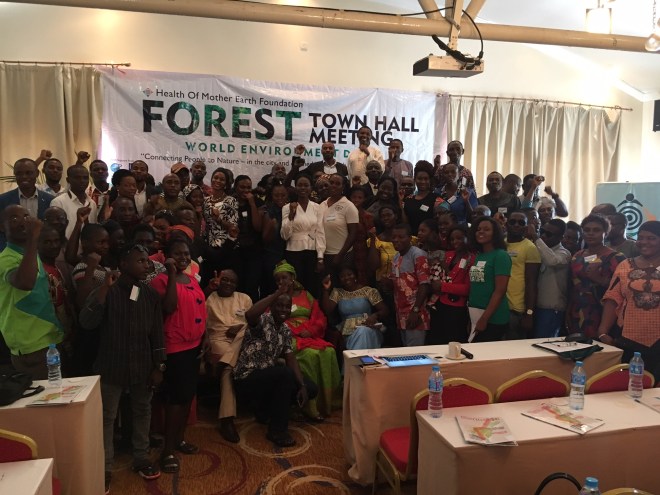
Group


Welcome words by Nnimmo Bassey at the Forest Town Hall:

What Nature Has Connected

The theme of this year’s World Environment Day, Connecting People to Nature, could not have been more apt, considering that humankind has lost the vital connections that make us conscious of our being a part of a community of beings on Earth.

Today we want to particularly look at the disruption of that connection by the politics of infrastructure that is sometimes pursued without recourse to national or even natural laws. We see roads build without drainages and where they are constructed, they are invariably emptied into streams and rivers without any consideration of the wellbeing of the aquatic life in them and of the people that depend on the water downstream.

I once asked the manager of a phosphate factory dumping toxic effluent into the Atlantic Ocean at Kpeme, near Lome, why such a harmful practice was permitted. The answer was that “you cannot make an omelette without breaking the egg.” If you ask why international oil companies have been routinely flaring gas in the Niger Delta over the past fifty-nine years, they claim it became “industry practice” because there was no market for the product when oil extraction commenced. Can you seen how low we can sink?

One of the infrastructural projects that has astonished the world and stunned local communities is the 260 km Superhighway proposed by the Cross River State Government (CRSG) to originate from a “deep sea” port at Esighi in Cross River State and rip through the National Park and community forests to terminate at Katsina Ala in Benue State.  This Town Hall meeting will examine what has been lost due to the commencement of the execution of the project without adequate public consultations, before an approved Environment Impact Assessment (EIA) and presumably before any detailed site-specific designs had been made. We will also examine what has been saved by the self-reversal of the order by which the CRSG had grabbed an amazing 10km span of land on either side of the proposed highway. That land uptake would have meant the displacement of several communities, conversion of pristine forests, decimation of wildlife and possibly the extinction of some species.

The idea of shaving pristine and protected forests for the installation of a highway of any form indicates a clear disconnection between people and Nature. The farcical community consultations so far carried out underscores the disconnection between the wielders of power and the citizens. The struggle waged by the communities to ensure that they are duly consulted and that their free prior informed consent is obtained before any project execution is an indication that a people connected to Nature would not readily allow any force to disconnect them from Nature on which they depend for livelihoods. This Town Hall will also seek to assure our threatened communities that we are united in the efforts to ensure that they are allowed to live in dignity, enhance their systems of knowledge and that the best interest of all beings is respected.

“We were not consulted before the superhighway was routed through our communities. We just saw bulldozers mowing down our trees, crops and properties. We insist that we must be consulted and that our consent must be obtained and due compensations paid for what has been destroyed and before any further work here. Our livelihoods depend on our environment. We cannot be treated like slaves in our own land.”

The forest dependent communities of Cross River State have shown exemplary commitment to protecting and managing their community forests. In attestation of their excellent performance, the Ekuri people were conferred with the Equator Prize by the United Nations Development Programme in 2004. Forests provide a variety of services to humans and other beings. Forests help to cool the Earth, protect our rivers, maintain soil quality, house wildlife. They provide food and medicine for humans and are home to pollinators. While the communities deserve to have good access roads, building any superhighway through the well managed forests would spell disaster of global implications.

Regrettably, Nature has become to many of us “a thing” that is to be appropriated, transformed and traded. We have gone so far from Nature that one sounds ridiculous to insist that we do not need to attach monetary values to Nature before we can protect her. This is the logic that undergirds the concept of Green Economy and promotes market environmentalism. We have forgotten the intrinsic values of the gifts of Nature and of Nature herself. We believe that all is not lost. We can wake up from the present nightmare and dream of better ways of living, of connecting with Mother Earth.

Today, we have deliberated chosen to mark the World Environment Day by having a Forest Town Hall Meeting. We note that parts of our nation are not being denuded by processes of desertification and the forest regions are rapidly becoming Sahellian.  The transformation cannot be blamed on climate change alone, although it does play a part in the area of desertification. Our disconnection from Nature has permitted us to clear our forests, destroy complex ecosystems, food systems and our social heritage without any reflections on the consequences of our actions. The loss of our forest ecosystems translates to the loss of culture, of ways of life, of possibly irredeemable destruction of species. These loses translate to direct deprivation of livelihoods and the exacerbation of poverty in our forest dependent communities.

We are pleased that the Federal Ministry of Environment has stood ready to review Environment Impact Assessment documents presented by the CRSG and that a nod would only be given when it is clear that all requirements of the law are met, including full consultation of the communities that would be impacted by the proposed project. We look forward to hearing thoughts and experiences from development and environmental experts as well as from representatives of communities threatened by the proposed that project.

I and my colleagues took part in an ecological community dialogue in Akpabuyo, one of the already impacted communities, last week. The lament of the people that still rings in my ear is this: “We were not consulted before the superhighway was routed through our communities. We just saw bulldozers mowing down our trees, crops and properties. We insist that we must be consulted and that our consent must be obtained and due compensations paid for what has been destroyed and before any further work here. Our livelihoods depend on our environment. We cannot be treated like slaves in our own land.”

What was implied is that we must not be disconnected from our land, from Mother Earth. In other words, what Nature has connected, let no person or government put asunder.


Unpacking Re-Source Democracy


Interrogating Re-Source Democracy. Progress has been measured by how much humans are able to transform Nature and increasingly this has been seen to be directly related to how exploitative of Nature and how polluting a nation or corporate entity can be. Clearly, the environmental crises confronting the world is inseparable from the economic crisis.

The current system denies reality. That is why the president of arguably the most powerful nation on Earth can wake up and exit from a global effort to fight a common challenge: climate change. That is when power trumps good sense. This myopic power denies science and even defies reasonable self-interest.   Although the Paris Agreement is largely inadequate, the pulling away of the USA, the second largest greenhouse emitter, from the global climate space, as outrageous as it is, only confirms that power only respects primitive, even harmful, self-interest.

The quest for materials and their transformation over the years have led to slavery, colonialism, autocracy and diverse socio-cultural corruption and manipulations. It has led to forceful dispossession of persons, communities and nations of their heritage through wars and other violent confrontations. This exploitative pathway, in which we have chiselled and drilled into the belly of the Earth, polluted our rivers and atmosphere, mowed down mountains, chopped down forests and poisoned our food systems, has taken humans further away from Nature over time.

Humankind’s quest for the control of Nature has led to the waging of unwinnable wars over natural forces and manifestations. Rising consumption and wastages have led to massive extinction of species and severe environmental changes – some of which may well be irreversible. Progress is largely measured by uniformity of products that yield to mass production, transportation and consumption. We seem to have forgotten that Nature thrives in diversities. This psychological and physical drifting from Nature is proving unsustainable as planetary boundaries and limits are being reached and exceeded.

The current global economic crisis will not go away as long as the current basis of relations stay. A capitalist economic system respects neither nature nor environment or peoples. It is based intrinsically on exploitative, competitive and non-regenerative relationships and cannot be sustained in perpetuity. When you don’t regenerate, you are not restorative and your actions are firmly planted on the path of degeneration. Even the accumulation of wealth by the 1 percent has reached its peak and the only way forward has to be down.

The current system denies reality. That is why the president of arguably the most powerful nation on Earth can wake up and exit from a global effort to fight a common challenge: climate change. That is when power trumps good sense. This myopic power denies science and even defies reasonable self-interest.   Although the Paris Agreement is largely inadequate, the pulling away of the USA, the second largest greenhouse emitter, from the global climate space, as outrageous as it is, only confirms that power only respects primitive, even harmful, self-interest.

Sustainability is not just a measure of a thing being available or useable in perpetuity. It also connotes its staying recognisable in form and speaks of intergenerational justice and responsibilities.

Re-Source democracy calls for a re-turn to the source, a re-connection to Nature. It calls for a recovery of memory. It calls for a dream of our preferred future or even multiple futures. It calls for the recognition of the fact that humans are just one of the species on Planet Earth and that we are a part of a system whose survival depends on interrelationships and solidarity.

To ensure Re-Source democracy, we have to be immersed in the defence of life and staying in the battle line against inequality as well as political and social injustices. We have to build a future that promotes cooperative and collaborative behaviours. That is what creates shared abundance, the good life or eti uwem. Scarcity is promoted by competition and that breeds all sorts of social and environmental misbehaviours.

Nature is self-regenerating, but human and corporate activities have brought in disruptions of those circles and cycles of life. Examples include the utter degradation of our environment by oil spills, gas flares, toxic wastes, industrial effluents and the like. It includes the exploitation of re-sources without prior informed consent of citizens in the territories. We have to pause to ask what the Niger Delta will look like by the close of the century. What would be the situation of the far North if desertification is not checked? What would be the case of our territories if gully erosion and deforestation continue unabated?

Environmental degradation disrupts our linkages to Nature, shrivels our humanity and throws us into unhealthy rivalry and struggles for whatever goods remain. It alters our thought patterns and social relations. It makes the unacceptable appear attractive and even acceptable. How would anyone drink water that is visibly polluted or eat foods that are clearly known to be toxic? How would we accept these without major uprisings?

What would make Nigeria stay in the present unsuitable unitary national architecture fabricated by military adventurers to suit their command structure? How could we dream of building a democratic and federal nation on the basis of autocratic and dictatorial military scaffolds? More questions can be asked, but let us restrict ourselves to the way we have treated Nature’s gifts to our nation. The arrival of crude oil and petroleum resources literally poisoned and damaged our environment, economy, politics and socio-cultural relationships. Agriculture got ignored, manufacturing got side-lined and all eyes got riveted on US dollars flowing into the national pot. We became captives of voodoo economics. Do nothing, grab everything.

Re-Source Democracy requires that we train our eyes to see what Nature has presented to every community and to what extent the communities are involved in decisions that affect the exploitation, protection or use of the re-sources in their territories. It requires that no one gets killed or colonised simply because of such endowments. It requires that we question how what we have is utilised and on what basis. It is about our right to life, freedom from contamination and respect of the Rights of Mother Earth.

We have hopes that unpacking the concept of Re-Source Democracy will provide us with ideas on how to redirect the nation from divisive and exploitation pathways and provide the platforms for truly democratic relationships with each other and with Nature – one that is built on local knowledge and wisdom. It should help us cultivate mutual respects between the many groupings in our nation. It should above all help encourage us to handle the gifts of Nature with due deference.

The Faculty of Social Sciences, University of Uyo provides an excellent academic environment for the interrogation of this existential challenges. And we are happy that you have welcomed us to be part of this conversation and probably many others to follow.

—-

Remarks by Nnimmo Bassey, Director of Health of Mother Earth Foundation (HOMEF), at the Sustainability Academy on the theme Unpacking Re-Source Democracy held at Bath Ebong Hall, University of Uyo on 2nd June 2017


Resilience, Resistance

Building a Resilient and Ecologically Engaged Citizenry. Cross River State is generally seen as a green state, with some of the last tracts of pristine rain forests – some of which have been preserved through community forest management efforts. Some of us believe that what the State needs is an economy creatively built on her bio-economic endowment. Such an approach would release the creative potentials of the citizens in an inclusive manner with inbuilt resilience. The rich soils and biodiversity of the State have however become a compelling pull for plantation or monoculture developers. Their incursions have put pressure on the local communities, especially the forest dependent ones. The incursions also have grave implications for national and global efforts to tackle global warming.

The suggestion that plantations are forests has been rejected by our peoples who insist that forests are biodiversity hotspots and that there can be no mono-cultures without the destruction of biodiversity. Biodiversity erosion degrades the resilience of communities at many levels – ecological, spiritual, economic, social and cultural. Biodiversity destruction can come from many actions including land use changes arising from conversion of forests into plantations as well as from infrastructural projects.

The controversies surrounding the Superhighway project idea have been consistently on rather basic premises. While some ask to know what would be exported at the Sea Port where the highway is to begin, others ask to know if the imported goods would terminate at Katsina Ala or where else they would go and how. These questions skirt the issue of the prime reasons offered for the Superhighway project – the urgent need to open up the State to investors and for development. The clouds over the project have been sustained by the lack of adequate public consultations on the routing of the highway, its necessity, its finance and viability and the trade-offs with regard to the massive community displacements and biodiversity destruction that would accompany it. Non governmental organisations (NGOs) like GREENCODE and Peace Point Action (PPA) have proposed that a railway system would be more cost effective in conveying goods from the seaport to the hinterland, besides having less impact on the environment.

These concerns have led communities and other citizens to demand a transparent Environmental Impact Assessment (EIA) process. That process has been unexpectedly tortuous for the Cross River State government (CRSG) because consultants engaged to help prepare the documents could not know, as pointed out by Rainforest Resource and Development Centre (RRDC), that there are no Chinese alligators, blue monkeys or even dams that would be found on the proposed Superhighway route. The versions so far seen appear to be cut-and-paste documents with scant relevance to the localities to be traversed by the Superhighway.

The CRSG has struggled to listen to public complaints and has reversed itself on the astonishing move it had made to grab 10km on either side of the proposed superhighway in order to create what had been described as a “development corridor”. That land uptake would have grabbed 25 percent of the landmass of the state and displaced up to 180 communities in the process.  Secondly, the CRSG is said to have realigned the superhighway so that it doesn’t traverse forest reserves. The problem with this is that with the route still falls within the fringes of forest buffer zones, the threats of illegal logging and opportunistic poaching remain very high.

Unfortunately, the CRSG has not been able to build the confidence of the public on the gains that the changes could have brought. This situation arises from the fact that while renouncing its initial edict to grab 10km on either side of the Superhighway, as well as sending out signals that the routing has been reconsidered, there have been threats and ultimatums made to the effect that the CRSG would proceed with the project even if the requirements of the law are not met; that they would consider revoking the ownership of the Cross River National Park. Moreover, the new routing of the proposed realignment of the Superhighway is still a conjecture as the revised map is not in the public view. The only maps that are accessible are those produced by the Wildlife Conservation Society (WCS). This speaks volumes about the preparedness of the State for the prosecution of this project in a way that addresses the concerns of the people and the unassailable need to protect our ecological heritage.

Today we are gathered here in Akpabuyo for a diagnostic Community Dialogue on the state of the local environment. We will examine issues including threats to our biodiversity and livelihoods. We will also examine what steps can be taken to preserve and enhance local livelihoods especially under the canopy of our reconnecting with nature, discussing re-source democracy and examining how to promote positive changes in the communities while minimising those with negative impacts. The purpose of our engagement today is to facilitate a process of distilling existing knowledge and bringing out action points that would build an ecologically engaged, resilient and proactive citizenry.

Our series of dialogues cover many ecological zones and have been supported by hosting communities, SGP-GEF of the United Nations Development Programme, Rosa Luxemburg Stiftung and Grassroots International. We thank leaders of Akpabuyo Community for making our dialogue today possible. We are also grateful to all the civil society groups and the media that are with us on this ecological journey.

We are only as resilient as our environment is. Let the dialogue continue.


Welcome words by Nnimmo Bassey, Director of Health of Mother Earth Foundation (HOMEF), at the Community Diagnostic Dialogue on the theme Building Resilience for Resistance held at Akpabuyo, Cross River State on 30th May 2017

In the Shadows of the Future (Poem)

In the Shadows of the Future

In a hide-away in Rustlers Valley

Lodged where the EarthRises to meet the mountains
Drawn by the call of caves and waterfalls
Enraptured by the pull of ancestral footsteps
Sucked into the silence of wisdom
Etched in the solidity of memories long grafted in our blood
We knew we were here thousands of years before
Humbled
We stooped
We rose
And beheld far flung horizons
Future Africa etched in a rocky vista
Global and Greengranting
Hope and solidarity
Pole pole

Things start from the bottom
Yet many prefer the summit
With eyes set at the pockets
Ladders kicked to secure lonely spots
Alone, encrusted in gold and diamond debris while
Folks at the bottom drown in acid mine drainage and still
Buffoons in power relish their tango in gilded caskets

In a hide-away in unnamed valleys
Taunted by numerous sunsets men celebrate
Burials in twisted metallic mind-sets
Dozing blinded by blinkers of exaggerated self-glory
Blind to
Soft trees
With roots tucked in stubborn soils
Split rocks
Yes, we are soft saplings
On the edges of the future
Ears pressed to the rocks we hear
Ancient rhapsodies we hear
Unspoken questions wafting in the air
Which is firmer as you ponder this mountain
Grass or rock?

Beholding solid shadows
We hear the oft whispered queries as
Hearts pump as we ponder the mountains of life
Are you ascending?
Are you descending?
What is the spiral locked in your DNA?
Standing in silence we
Untwist our minds as we
Stand at liberty at the feet of Mother Earth as we
Eliminate blinkers of exaggerated self-glory we
Know that saplings
With roots hooked in stubborn soils
Will split the most stubborn rocks
Pole pole

As we ponder the shadows and the cracks
This poem will be finished…
In the valley or
on the mount


(For Jay Naidoo & Stephen Pittam)

11 May 2017

Break Monsanto and Bayer’s Unholy Wedlock

Breaking the Unholy Wedlock between Monsanto and Bayer.The quest for profit in the agro-chemical sector is being pursued through the power game of colonisation of seeds and farming systems. Monocultures literally operate best in command systems where control is concentrated in a cabal or in a few hands. This is what the merger of Bayer and Monsanto seeks to solidify. This is why we resist this merger because its consequences will be dire. This is why citizens of the world reject this quest for the control of global agriculture, the poisoning of our food systems and the erosion of biodiversity. This is why we are extremely concerned in Africa even though this commercial enterprise appears to be between Europe and North America.

Monsanto’s Bt cotton in Burkina Faso failed fantastically when farmers harvested short-fibre cotton leading to economic losses. On 14th April 2016, the government of Burkina Faso make a determined turn around and halted the cultivation of the failed Bt cotton.

We are concerned because right now, big agri-business led by Monsanto and their political backers have worked hard to weaken laws that should protect biodiversity in Africa and ensure biosafety and biosecurity. They have assaulted our political structures and painted horrid pictures of hunger, malnutrition and starvation across the continent, prescribed techno-fixes and refused to interrogate the root causes of the symptoms. The technical fixes such as the products of genetic engineering are patently colonial insults being foisted on Africa. They ignore socio-cultural, ecological, economic, religious and ethical realms of our peoples. They present themselves as innovations, but are nothing more than unwanted tools seeking markets and dominance.

So far, genetically engineered crops are officially planted in just a few African nations – South Africa, Sudan and Egypt. Cultivation of Monsanto’s Bt cotton in Burkina Faso failed fantastically when farmers harvested short-fibre cotton leading to economic losses. On 14th April 2016, the government of Burkina Faso make a determined turn around and halted the cultivation of the failed Bt cotton. From that time farmers in Burkina Faso began to cultivate non-GE cotton and are already boasting of excellent quality cotton, rise in outputs and better financial returns.

thumb_img_0761_1024-2

The critical situation for us in Nigeria is that in the dying days of our previous government, a very defective biosafety regulations law was signed into force. Within a year of the coming into effect of that law, Monsanto applied for and obtained three permits to introduced GE crops into Nigeria – two maize events and the same variety of Bt cotton that failed woefully in Burkina Faso. Two of those permits where obtained from applications that Monsanto made jointly with a National Biotechnology Development Agency (NABDA) which is a member of the board of the regulatory or permitting agency. Our struggle in Nigeria is multi-layered. We are struggling to overturn the legislation that has conflicts of interest embedded in it. We are also struggling against a food production system that would see our peoples and environment doused with toxic carcinogens, such as the ones peddled by Monsanto. We are resisting the destruction of biodiversity through industrial agriculture that will worsen land-grabbing on our continent with the related displacement of small holder farmers. We are resisting a system that will lock in hunger and malnutrition and raise the spectre of the enslavement of our peoples through obnoxious labour and commercial practices.

With our staple crops such as cassava, beans, bananas and maize being targeted by the GE and chemical companies, the merger of Monsanto and Bayer will spell doom to our smallholder farmers. It will destroy our indigenous species and pressure our farmers to adopted a few dominant technological packages. It will mean destruction of our farming patterns of mix-cropping, colonise our seeds, expose our farmers to high costs of seeds and greatly hamper our food sovereignty – the right to safe and wholesome food. We cannot accept the merger of these two sellers of toxic technologies. When we reject this merger and the technologies and chemicals bringing them together, we are resisting the conversion of Africa into a dumping ground of obsolete technologies, unwholesome foods and the erasure of our biodiversity. We are standing against yet another attack on the survival of our peoples – a war now fought through seeds rather than bullets.

Thank you for listening. Thank you for solidarity. That you for excusing my inability to be with you today. We are in this struggle together. Until Victory!

C-bhYcaXsAASTYA.jpg-large


Talking points used in virtual presentation at the Town Hall meeting at University of Koln on 27.04.17


We Have a Right to Safe Food

Safe Food is a Human Right. Should science not be in the public interest and in service of society? The answer to that is obvious and it is a YES. Science has to be in the interest of society. Is all science in the interest of society? Again, this question attracts an easy answer and that answer is NO.

Must a people utilize a technology based on unproven or mythic promises? Indeed, must we use a technology simply because it exists or because we can acquire it? Does domesticating a technology, such as modern agricultural biotechnology, make its utility inevitable? Do nations shy away from utilising the technology that produces atomic bombs merely for lack of access to the technology or for reasons of safety and survival of humankind? Where does public participation begin and where does it end with regard to decisions that are matters of life and death?

If we are malnourished what must be done? Can food aid solve the challenge of food shortages in the North East when the root causes fester and lurk under every shrub or clump? Why are fisher folks in our Niger Delta creeks depending on imported frozen fish?

How much do we know of the GMO beans that will soon be unleashed on Nigerians? And what does the public know of GMO cassava experimentations/release in Nigeria? What about the approval of GMO cotton that failed in Burkina Faso for commercial release in Nigeria? Burkina Faso’s cotton production is regaining its former productivity since the government decided to jettison the GMO variety and return to planting natural cotton. Why is Nigeria being pushed blindly into a failed venture? We cannot be fooled when we are told that a permit for commercial release and placement in the market is the same as a permit for trials to be conducted.These questions are raised to remind us that there are many issues surrounding the matter of our food and

the challenge of agricultural modern biotechnology that require clarifications and in-depth interrogations.

On 13th November 1996, the World Food Summit hosted by the United Nations, the world affirmed that all humans have a right to access to safe and nutritious food in a manner consistent with the right to adequate food and freedom from hunger. The provisions for the right to life in our constitution and other global covenants speak of the right to food that is safe and nutritious.

As we begin our conversations on the state of biosafety in Nigeria, let us state that the fundamental way to ensure safe, nutritious food is through the promotion and support of food sovereignty. This is the way to ensure sustainable food production. Food sovereignty is the right of peoples to safe and culturally appropriate food produced through methods that are ecologically sound and sustainable. It is critically the right of our peoples to define their own food and agriculture systems. It allows communities to control the way food is produced, traded and eaten. We understand that the best food security can be attained through food sovereignty. Any other understanding of food security leaves open the gates for dumping of inappropriate foods and products with the singular end of filling hungry mouths and stomachs. It essentially erodes a people’s sovereignty and promotes food colonialism.

The media has an enormous responsibility to inform the public about issues that fundamentally affect their safety – especially with regard to the sort of food or things that we eat. It is a sacred duty to lay open basic information and to encourage public participation in policy issues surrounding our food systems. We have a biosafety law, the National Biosafety Management Agency Act 2015, that is not only permissive in favour of the biotech industry, but is adversarial or against the public interest. This is illustrated by the fact that the Act only requires NBMA to hold public consultations at its discretion as in its Section 26(1). We believe that holding public consultations on plans to release genetically modified organisms should be a legal and binding requirement and not left to the whims of the Agency. Section 25(2) of the Act also allows NBMA to decide whether to advertise applications to introduce GMOs in national or local newspapers.

The ‘public enlightenment’ events held by promoters and regulators of biosafety in Nigeria merely suggest that our people are misinformed about the risks that GMOs pose. What our people need is accurate information from all sides of the issues so that they can make informed decisions and demand for or reject risky technologies. Assurances that NBMA will not allow dangerous GMOs into Nigeria are nothing but mere platitudes if the claims are not backed by open, neutral and unstilted adjudications.

How much do we know of the GMO beans that will soon be unleashed on Nigerians? And what does the public know of GMO cassava experimentations/release in Nigeria? What about the approval of GMO cotton that failed in Burkina Faso for commercial release in Nigeria? Burkina Faso’s cotton production is regaining its former productivity since the government decided to jettison the GMO variety and return to planting natural cotton. Why is Nigeria being pushed blindly into a failed venture? We cannot be fooled when we are told that a permit for commercial release and placement in the market is the same as a permit for trials to be conducted.

As the conversations begin, let us all keep in mind that this is a matter of security, cultural heritage, freedom from neo-colonialism and a human right to life. We are talking about food. And food is a human right.

Let the conversations continue.

———————————————-

Welcome words by Nnimmo Bassey, Director of Health of Mother Earth Foundation (HOMEF), at a Media Training on Biosafety hosted by HOMEF at Apo Apartments, Abuja on 24 May 2017

Eco-Instigator #15 : Promoting Biosafety in Nigeria

ECO INSTIGATOR 15 coverThe heat is on, as the saying goes. As the forces of environmental harm increase the heat on the planet, ecological defenders are stepping up on mobilisations and vigorously standing up for justice.

One key trending environmental matter in Nigeria in the rst quarter of 2017 was the soot or black carbon that blanketed Port Harcourt. The visible pollution got people talking and government agencies scrambling to check the situation.

Another boiling issue was that of Biosafety or the threats of genetically modied organisms (GMOs) in Nigeria. An innocuous newspaper report relaying the ndings of an ad-hoc committee of the Nigerian Inter-Religious Council (NIREC) set up to advise the body on issues of genetic engineering has led to strenuous rebuttals and disclaimers from public agencies working on Biosafety and GMO issues. We serve you the report, the rebuttals and our own response. This is a matter that requires continuous vigilance and we promise to return to it in Eco-Instigator #16.

Always on the go? Check out the article by Sonali Narang on the need to watch our carbon footprint. And we serve excellent poetry from the pen of one of Nigeria’s acclaimed poets, Amu Nnadi.

Read, think, react, reach us. Until victory!

Read the edition here: ECO INSTIGATOR 15

What We Eat (must not eat us)

IMG_5511What We Eat (must not eat us): The key myths by which citizens are sold the idea of GMOs as being desirable include that they provide the most assured way of feeding the burgeoning population of hungry mouths in the world. The planks on which this highly seductive myth has been erected are quite flimsy. Research has shown that GMOs do not necessarily yield higher than normal crops, making the talk of producing more food by using GMOs simply fatuous. Secondly, over one third of food currently produced in the world today simply gets wasted, while most of the GMOs currently grown in the world end up as animal feed.

The need to interrogate our biosafety has become very pertinent because of the many myths around modern agricultural biotechnology. These myths are being peddled regularly by the industry promoting genetically modified organisms (GMOs) and their team players in public offices. A major plank on which biosafety, and perhaps biosecurity, rests is the precautionary principle[1]. This principle, or approach, is a safeguard against the permission or introduction of products or elements into the environment where there is no scientific consensus that such an introduction would be safe or would not have an adverse impact. In other words, the precautionary principle helps to disallow the use of citizens as guinea pigs in experimental release of products that could harm them. The argument that there is a risk in everything is hollow and an acceptance of that as an excuse to expose citizens to harm is inhuman.

In this engagement on biosafety we hope to share information on the issues of biosafety and GMOs in Nigeria and Africa. The aim is that media practitioners would be able to sift the facts from the myths, and by so doing help the public to require a sense of responsibility from our biosafety regulators, research institutions, political forces and commercial interests behind the risky genetic engineering approach to food production.

The key myths by which citizens are sold the idea of GMOs as being desirable include that they provide the most assured way of feeding the burgeoning population of hungry mouths in the world. The planks on which this highly seductive myth has been erected are quite flimsy. Research has shown that GMOs do not necessarily yield higher than normal crops, making the talk of producing more food by using GMOs simply fatuous. Secondly, over one third of food currently produced in the world today simply gets wasted,[2] while most of the GMOs currently grown in the world end up as animal feed.[3]

Another argument used to sell GMOs is that they require the use of less chemical in terms of pesticides and herbicides because the crops can be engineered to withstand herbicides or to act as pesticides themselves. The emergence of what have been termed super weeds and superbugs have dented that claim as farmers have had to sometimes apply stronger doses of herbicides and pesticides on farms where such weeds or pests emerge. In any case, the herbicide known as Roundup/glyphosate to which crops engineered by Monsanto are resistant, has been said to be a ‘possible’ source for cancer.[4]

Evidence is now mounting that there has been a collusion by biotech companies and regulators in the USA to conceal the fact that glyphosate is indeed a probable human carcinogen. One Environmental Protection Agency official, Marion Copely, in a 2013 email[5] stating the following ways in which glyphosate can cause cancer:

  1. Endocrine disruption
  2. Free radical formation and inhibition of free radical-scavenging enzymes
  3. Genotoxicity — which is key in cancer onset
  4. Inhibition of certain DNA repairing enzymes
  5. Inhibiting the absorption of essential nutrients
  6. Renal and pancreatic damage that may lead to cancer
  7. Destruction of gut bacteria and suppression of the immune system

The official (who has cancer and passed on in 2014) added, “Any one of these mechanisms alone listed can cause tumors, but glyphosate causes all of them simultaneously. It is essentially certain that glyphosate causes cancer. With all of the evidence listed above, the CARC category should be changed to ‘probable human carcinogen.’”[6]

A report published yesterday by Global 2000 shows that between 2012 and 2016, biotech companies sponsored a series of review articles asserting that glyphosate and its commercial formulations are not injurious to health. The Global 2000 report, “buying Science” reveals that the industry-sponsored reviews of glyphosate’s carcinogenicity and genotoxicity (ability to damage DNA) have serious scientific flaws, including assigning greater weight to unpolished studies than peer-reviewed ones. The papers are said to also have introduced irrelevant data in violation of standard guidelines for the evaluation of cancer studies in rodents. Moreover, the reviews also consistently assign greater weight to unpublished industry studies than to studies that were peer-reviewed and published in scientific journals.[7]

The National Biosafety Management Agency (NBMA) on 1st May 2016 approved for Monsanto/NABDA to introduce genetically engineered maize varieties that would depend on this cancer-causing weed killer. Responding to objections to the permits and the obnoxious chemical, Monsanto issued a press response claiming that the chemical would not offer any cause for worry if farmers apply them strictly according to the guidelines or labels on the packets.[8] We note that overwhelming evidence show serious health impacts of agro-chemicals on persons working on farms planted with GMOs or living in close proximity to such farms.[9]

We invite journalists to interrogate the fact that GMOs are grown as mono-cultures and consider what this would mean to our agricultural system which is anchored on mix-cropping that promotes diversity and resilience. It also pays for us to look at the woeful performance of GMO cotton in Burkina Faso where the crop is being phased out and the remarkable failure in Makhathini Flats in South Africa where it was showcased as a grand success for small scale farmers in the late 1990s. We should point out that it is the same failed GMO cotton that has been halted in Burkina Faso that has been permitted to be commercially released into Nigeria.

You will hear in this programme how our regulatory agency works in cohort with GMO promoters and where official GMO promoters are interlocked with Monsanto, as for example in the GMO maize application and approval. As one ancient philosopher said, we simply have to believe the evidence of our “eyes” before we jump unto the GMO bandwagon in the pretext that we are doing science, claiming that all is well, when there are deep wells of doubts concerning the technology.

As we speak, GMO products are already on our market shelves. And a plethora of field trails of others are ongoing, including that of GMO beans that may be introduced into the Nigerian markets by 2019, according to the promoters[10]. HOMEF and other critical observers have scrutinized the NBMA Act of 2015 and found critical clauses in it that makes its capacity to protect our environment and health very questionable. We have also proposed how this situation can be remedied: either a total repeal of the act or a drastic review of the questionable provisions.

My task is to declare this training open. I do so now. And I urge you to engage and contest any ideas you are not in agreement with. And do see our publications, including our GMO Factsheet for more information. We should be concerned about what we eat. And we should not be forced to eat what we do not want to eat.

Let the conversations proceed.

Welcome words by Nnimmo Bassey, Director of Health of Mother Earth Foundation (HOMEF) at Media Training-Promoting Biosafety in Nigeria held in Benin City , Nigeria, on Friday, 24th March 2017

Notes

[1] http://www.precautionaryprinciple.eu

[2] UNEP. 2016. Food Waste: The Facts. http://www.worldfooddayusa.org/food_waste_the_facts

[3]David Johnson and Siobhan O’Connor. 2015. These Charts Show Every Genetically Modified Food People Already Eat in the US. Time Health.  http://time.com/3840073/gmo-food-charts/

[4] Roundup weedkiller ‘probably’ causes cancer, says WHO study. https://www.theguardian.com/environment/2015/mar/21/roundup-cancer-who-glyphosate-

[5] See report on “Heartbreaking letter from dying EPA scientist begs Monsanto “moles” inside the agency to stop lying about dangers of RoundUp (glyphosate)” at http://www.naturalnews.com/2017-03-15-heartbreaking-letter-from-dying-epa-scientist-begs-monsanto-moles-inside-the-agency-to-stop-lying-about-dangers-of-roundup-glyphosate.html

[6] Vicki Batts. March 23, 2017. Thousands of people now have non-Hodgin’s Lymphoma due to glyphosate (Roundup) exposure, warns legal firm that’s suing Monsanto. http://www.naturalnews.com/2017-03-23-thousands-of-people-now-have-non-hodgkins-lymphoma-due-to-glyphosate-roundup-exposure-warns-legal-firm-thats-suing-monsanto.html

[7] GM Watch. 23 March 2017. New report shows glyphosate producers are “buying science.” http://gmwatch.org/news/latest-news/17518

[8] Ben Ezeamalu. June 11, 2016. Monsanto responds to PREMIUM TIMES’ report, says own modified crops ‘safe.’ http://www.premiumtimesng.com/news/more-news/205109-monsanto-responds-premium-times-report-says-modified-crops-safe.html

[9] Paul Koberstein. June 16, 2014. GMO companies are dousing Hawaiian island with toxic pesticides. http://grist.org/business-technology/gmo-companies-are-dousing-hawaiian-island-with-toxic-pesticides/

[10] Zakariyya Adaramola. November 29, 2016. Nigeria to get GM beans in commercial quantities by 2019- NABDA. https://www.dailytrust.com.ng/news/health/nigeria-to-get-gm-beans-in-commercial-quantity-by-2019-nabda/173748.html

NOT ON OUR PLATES! Nigeria does not need GM food

Not on our Plates!Nigeria does not need GM crops to satisfy its food and agriculture needs. We know exactly what we have to do and the Nigerian National Conference[i] of 2014 raised the caution with regard to then draft National Biosafety Bill. We agree with the concerns raised by the Conference and urge that the NBMA Act should be critically reviewed or repealed.[i]

The few crops commercialized during the past decades were mostly composed only of two traits, and their area of cultivation has been limited to a handful of countries. Over 90% of GM crops concentrated mostly in five countries– USA, Brazil, Argentina, India, and Canada, with the USA accounting for 40 per cent of all GM global area.[i]

In any case, after two decades of GM crops commercialization, up to 95% of the staple crops which have been commercialized are insect resistant or herbicide tolerant. The push for the introduction of these type of GM staple crops has been led either directly by the big biotech corporations that developed the product or their subsidiaries.

None of these traits, however, provide any benefit to the consumer, and none of them as of today has managed to win the heart of the majority of the consumers. For instance, even in the US, the cradle of GM crops, a poll conducted by the New York Times in 2013 concluded that three-quarters of Americans expressed concern about genetically modified organisms in their food, with most of them worried about the effects on people’s health.[ii] In The reality of such scepticism has forced the biotech industry to desperately seek to widen its market into Africa. The claim that Europe is influencing Africans to reject GMOs is grossly erroneous.[iii]

Not on Our Plates… and read the full Not on Our Plates…

[i] Alessandro Sorrentino, et al. October 2016. “Regulatory Policy and Economic Implications of GMO in Agriculture: A review.” See at https://www.aur.edu/wp-content/uploads/2016/08/SORRENTINO_BRANCA_-Food-governance_GMO.pdf

[ii] Allison Kopicki. July 27, 2013. Strong Support for Labeling Modified Foods. New York Times  https://www.nytimes.com/by/allison-kopicki

[iii] http://www.newvision.co.ug/new_vision/news/1339024/european-union-policies-detrimental-africa

Biotechnology, ‘Scientists’, ‘Experts’, Government Agencies and Patriotism

Biotechnology, ‘Scientists’, ‘Experts’, Government Agencies and Patriotism. Generally, when we speak of patriotism we evoke a sense of ‘nationalism’ and ‘loyalty’ to one’s nation or group. From the perspective of some commentators, patriotism means endorsing without question anything that a government or government agency suggests or does. Permit me to equate that to the Warrant Chief mentality of the colonial era. The colonial governments would have seen those chiefs as epitomes of patriotism. But we do know that they were loyal to foreign interests rather than the interests of our peoples or nations. We can further say, that the mind-set that holds that government action is always right and must be supported willy-nilly is a very dangerous mind-set.

The need to interrogate what patriotism means in the context of the challenges of the push of modern agricultural biotechnology into Nigeria and Africa has been instigated by an article by a “Lagos-based research scientist” titled “Biotech agencies NIREC report and unpatriotic activism.” That article opened with this claim: “Recently, a group representing the National Inter-Religious Council (NIREC) issued a press release with the intention of misleading the public and pursuing an alien agenda.”

I have personally not seen the “statement” that was supposedly released by NIREC and probably would not have learned of the publication in Daily Trust, but for the strident responses from the government agencies and their proxies. I also have strong doubts that the Daily Trust publication was a press release “from a group representing the National Inter-Religious Council (NIREC).” The source of the story, however, is not our concern here.

Generally, when we speak of patriotism we evoke a sense of ‘nationalism’ and ‘loyalty’ to one’s nation or group. From the perspective of some commentators, patriotism means endorsing without question anything that a government or government agency suggests or does. Permit me to equate that to the Warrant Chief mentality of the colonial era. The colonial governments would have seen those chiefs as epitomes of patriotism. But we do know that they were loyal to foreign interests rather than the interests of our peoples or nations. We can further say, that the mind-set that holds that government action is always right and must be supported willy-nilly is a very dangerous mind-set.

For an immediate modern day example by which we can examine the puerile claim that government (agency) worship is equal to patriotism, we only need to look at the current resistance to the travel ban proposed by the president of the United States of America. The president proclaimed a ban, the world was aghast, legal challenges were instituted, the government lost and a revised ban was issued. As we write, a court has blocked that new presidential order. It is our guess that those who object to the travel ban can be labelled unpatriotic, after all the orders were issued by a president. No applause for such logic. We must ask ourselves why biotechnology proponents find it hard to accept that their ideas can be questioned and that they could be wrong, as they often are. The falsehood of the myths of the biotechnology industry have been demonstrated continuously and shown for what they are. Moreover, Nature repeatedly trumps the myths – through super weeds, superbugs, etc..

Top officials of NBMA and NABDA had in time past been invited to our events, we would never put their names in our flyers or be under any illusion that they are no longer promoting the ‘deployment’ of GMOs in Nigeria because we invited them to our events. We know they would not flip their script.

Let us linger a bit more on criticism as lack of patriotism. What is patriotic about foisting on Nigeria a technology that has failed woefully in Burkina Faso, a neighbouring country? How come we are wishing away the fact that the quantity and quality of cotton harvests in Burkina Faso has picked up since they escaped the GMO hoax?

What is patriotic about forcing down our throats, a system that was sold as revolution for small scale farmers in Makhathini Flats, Kwa Zulu Natal, South Africa in 1998 but failed woefully?

We will look at other issues in the article written by the Lagos-based scientist who apparently must be an insider in one or both of the agencies defended in the article. The scientist appears to have the voice of Jacob, but the hands of Esau.

The argument that anyone opposing GMOs is doing so for pecuniary reasons, or is acting as someone’s stooge, is laughable. That same argument can be extended to those of us opposed to criminal oil pollutions, toxic dumps and the like. The same can be said of those of who fought against military dictatorship in Nigeria, against apartheid in South Africa or slavery in the USA. It is a weak, poor and worthless argument that does not even merit a response. What would the Lagos-based scientist say of the web of actors and sponsors that are openly funding and pushing for the deployment of GM crops in Africa?

The committee that NIREC set up to review the GMO situation in Nigeria was an advisory one made up of academics, researchers and people of faith. To my knowledge, apart from secretariat support, members were/are not part of NIREC. The committee invited the two key institutions promoting or overseeing the “deployment” of GMOs in Nigeria.

Finally, the Lagos based scientist stated in the article under reference and we quote: “Nnimmo Bassey was an active player in the processes that cumulated in the establishment of the NBMA, so to turn around and say that the Agency is a brain child of NABDA questions his credibility and integrity.” (our emphasis).

Let us go back to what we wrote in the article that drew the ire of the Lagos-based scientist. Here is it: “A preliminary comment that is of important at this point is that these two agencies operate like conjoined twins. And that may be so because NBMA is purportedly the brainchild of NABDA. No, that is not my imagination.”

Note that I used the word “purportedly” and then added that I did not imagine that curious supposition. The fact is that the disclosure that NBMA was a brainchild of NABDA was stated by the official that represented one of the agencies when they appeared before the NIREC committee. We do not think it is important to say who among the two made that incredible claim. But if anyone really wants to know the information it can be shared. This writer did not imagine, claim or say it. The revelation unveils the foundational flaw of the GMO scaffold.

In any case, those who promoted the NBMA Bill have their logos printed on the back of the document that was distributed at the Public Hearing on the Biosafety Bill Organised by the Joint Committee on Science and Technology and Agriculture, ABUJA, 9th December 2009, at the National Assembly. To suggest that this writer ever endorsed what was signed into law by our former president is an incredible distortion of the truth. When we recognise that we have a bad product, two of the ways to respond is dropping it or reviewing it. One of the organisational flyers of NBMA carries the names of individuals, including those from CSOs that are totally opposed to GMOs but attended one of the meetings in the preparatory stages of the bill that has become law. Why are those names listed on a promotional flyer? To gain credibility? To silence opposition? Did their attendance indicate that they endorsed the bill? Top officials of NBMA and NABDA had in time past been invited to our events, we would never put their names in our flyers or be under any illusion that they are no longer promoting the ‘deployment’ of GMOs in Nigeria because we invited them to our events.  We know they would not flip their script.

In conclusion, let us just state that no law is cast in concrete, although even concrete cannot last for ever. No matter what the current GMO promoters say, believe or defend, the fact remains that a defective piece of legislation ultimately will be reviewed or jettisoned. The same will be the terminal point of a technology whose obsolescence is already appearing.


[*] Nnimmo Bassey is Director of the ecological think tank, Health of Mother Earth Foundation (HOMEF)