 We need alternative power scenarios to achieve needed power alternatives. The word power has many synonyms. Some of these are influence, authority, control and dominance. The term has interesting definitions in politics, military, religion, electrical, sports, law and mathematics. In physics it refers to energy produced by means such as electrical or mechanical ones in order to operate a device. Electric power can come from a variety of sources including solar power, fossil, nuclear systems, steam, thermal power, waves and hydro power. When a nation considers or uses a variety of these sources for secondary energy production, this is referred to as an energy mix.
We learn something about power when we consider its meaning beyond that of mechanically getting something moved from one point to another or getting a device to produce something. In social science and politics, power is defined as the capacity to influence the actions, beliefs, or conduct of others by an individual. We will return in a moment to examine the importance of power in the socio-political context.
The Tussle over Dams
A tussle continues between Ethiopia, Sudan and Egypt over Ethiopia’s Renaissance Dam on the Blue Nile. While Ethiopia wishes to become a net exporter of electric power, Egypt worries that the dam will constrict its share of the river if it is filled up too quickly. Sudan on the other hand could benefit from cheaper electricity from the power project but could also suffer catastrophic flooding if the dam fails. Tensions are running high as recent talks by the three countries did not yield a deal.
Meanwhile a mammoth Grand Inga hydropower project with a generation capacity of 40 GW is proposed to be built on the Congo River in the Democratic Republic of Congo. Conceived as the largest dam in the world, the scheme would be realized in three phases. Inga 3 with a capacity of 4.8 GW of power was originally announced in 2013 with the support of the World Bank at an estimated $14 billion price tag. The World bank withdrew in 2016 and a redesigned Inga 3 now has Chinese interests and is planned to produce 10 GW of power. Some of that power may head to Nigeria. Inga dams 1 and 2 built under the Mobutu regime in 1972 and 1982 had installed capacity of 2,132 MW and are said to have never produced more than 40 percent of their capacity. Although up to 90 percent of DRC’s population do not have access to electricity, this scheme is planned to mostly supply mining companies in the country as well as industrial establishments and urban centres in South Africa.
Governments Trapped in Crude
The oil price slump driven by the coronavirus pandemic may be easing, but confidence in the resource is not building up as fast as the crude oil dependent African nations would wish. Reports indicate that although “massive oil and gas discoveries have been made in Africa this century — from Ghana to Mozambique — the prospects of similar ones in the future look bleak” because operators are not investing as enthusiastically as expected. It is indeed believed that low oil prices have forced drillers to cut down on risky frontiers and that oil rigs are disappearing from Africa at a rapid pace.
While the rigs may be shifting away, the fossil industry has a peculiar hold on financial speculators or shareholders. Oil companies shore up their value by showing how much oil reserves they have. That way investors can peep into the distant future and see their investments secured in the oily soup. Consider the Mozambique LNG project operated by TOTAL. The company is sealing a deal to finance the project through the monetization of the reserves in the deepwater Area 1 of that country.
There is no shortage of huge fossil fuel projects in Africa. There is the $20 billion Ogidigben Gas Revolution Industrial Park (GRIP) owned by the Nigerian National Petroleum Corporation (NNPC); the $13.5 billion Etan & Zabazaba Oil Fields offshore Nigeria owned by Eni and Shell; the $12 billion Namibe Refinery Complex in Angola with two Russian investors holding 75 percent shares; and the $11 billion Dangote Refinery and Polypropylene Plant at Lekki Free Trade Zone, Lagos.
Oil dependency has spelt a big challenge for African governments and this has been heightened by the pandemic. According to International Monetary Fund’s data, the breakeven prices for some African countries are as follows: Nigeria – $144 per barrel, Algeria – $109 per barrel, Libya – $100 per barrel, and Angola – $55 per barrel. With such high baselines and with oil prices currently below $50 per barrel, combined with the fact that the world is gradually shifting from this energy sources, it is clear that countries dependent on crude oil revenues are in for prolonged financial stress except they wake up from slumber and diversify their economies. In response to the revenue debacle, Nigeria has applied for about $7 billion in emergency loans as of April 2020. For how long can we go on this way?
Should Africa’s Energy Needs trump Climate Change concerns?
There is no doubt that Africa needs electric power and a whole lot of it. According to the African Development Bank(AfDB), “Over 640 million Africans have no access to energy, corresponding to an electricity access rate for African countries at just over 40 percent, the lowest in the world.”
With this level of power deficit on the continent, the obvious response is that the gap must be closed. Some have said that this gap must be closed “by any means possible.” By the way, when Frantz Fanon penned those terms, and when Malcom X used them at the founding rally of the Organisation of African Unity (OAU), they obviously did not have self-harming connotations in their minds.
Electric power by any means suggests burning of more oil, gas and coal and use of nuclear power or big dams. These will generate the needed power, but what would it do to the climate? Africa is already one of the most vulnerable regions in the world, with temperatures rising more rapidly than the global average in some places. Extreme floods, cyclones, droughts and even locust invasions have grave implications for the continent.
At a recent webinar, a participant asked this question, “Is it fair not to allow countries in the global South to adopt the destructive pattern that built the global North?” This appeared to be in sync with a statement made by Gabriel Obiang Lima, the minister of Mines and Hydrocarbons in Equatorial Guinea: “Under no circumstances are we going to be apologizing, …Anybody out of the continent saying we should not develop those [oil and gas] fields, that is criminal…”
Alternative socio-political power scenarios inspire the pursuit of power and energy alternatives. It is time for the intensification of community dialogues and the convening of peoples’ assemblies to determine what constitutes development and progress as well as to what ends Nature must be transformed. There is a critical need to disconnect our dreams and plans from the narratives of climate deniers and scenarios that lock us into interests of extractive corporations and politicians seduced by revenue sources that discount both the people and ecological costs.
The question is whether Africa’s need for electricity trumps our climate change challenge. Some analysts argue that as much as climate concerns are real, switching away from fossil fuels dependence will be misguided. We need to debate “development” and what being developed means.
Oilwatch International has been demanding that fossils be kept in the ground for over two decades now. This started before #KeepItInTheGround became a popular hashtag. Oilwatch is basically a global South network focusing on halting the expansion of destructive fossil fuel activities in the global South. The network recognises the need for power, but it also recognises the right of our peoples to life and dignity.
Alternative Power for attainment of Power Alternatives
Let us return to the question of power in the socio-political lens. We remind ourselves that it talks about the capacity to influence the actions, beliefs, or conduct of others. It is in this space that we can see possibility of drawing the line between drowning and dying with lights on or living and thriving with lights on. With the right political power, we can agree on, and deliver the right electric power.
Africa may resist the shift from fossil fuels on the basis of the argument that it is unjust for those who have benefited from the use of fossil power to now demand that Africa shuts down her few fossil power plants and plunges into darkness, bearing the brunt of climate action while the rich polluting nations and oil companies enjoy the spoils of their exploitation with no responsibility for historical recklessness and even crimes. The middle ground for this would be that the global North immediately shifts from polluting fossil energy while the global South engages in a managed decline, weaning off and shifting to cleaner energy in a gradual mode.
The point is that for this demand to be made in a convincing manner, Africa must have leaders with a climate justice mindset. The dominant neoliberal mindset that pursues projects and climate finance rather than the payment of climate debt will not do. A mindset that accepts the commodification of nature and false solutions such as carbon colonialism and slavery, that sees the continent as a huge carbon sink or data mine will not do.
We need a climate justice mindset that drives the political will to draw an immediate and long-term plan to power Africa from the abundant renewable resources she has, ensuring that these do not come with green land grabs and diverse dispossessions of poor communities and peoples. We need a new mindset to build alternative power structures that would birth continent-wide distributed renewable energy micro-grids managed by communities and associations and not shylock private companies.
We need an alternative power structure, one that is people driven, that builds power with the knowledge that you do not have to extract and use a resource simply because you have it. A system that understands that you don’t have to exploit a resource simply because it has a financial value while ignoring the values of liberty, dignity, solidarity and intergenerational equity. It is a good time also to define and debate development. Where has the current mode taken the world?
Alternative socio-political power scenarios inspire the pursuit of power and energy alternatives. It is time for the intensification of community dialogues and the convening of peoples’ assemblies to determine what constitutes development and progress as well as to what ends Nature must be transformed. There is a critical need to disconnect our dreams and plans from the narratives of climate deniers and scenarios that lock us into interests of extractive corporations and politicians seduced by revenue sources that discount both the people and ecological costs.
——————————
Presentation at Health of Mother Earth Foundation’s Climate Change and Power Alternatives Dialogue/Webinar on 22 June 2020
 Freshwater and Marine Ecosystems in the the Gulf of Guinea and the Congo Basin face a lot of challenges and this year’s World Oceans Day offers us a good anchor for reflection. The theme of this year’s World Oceans Day is

 A key fact we have to face is that the coronavirus will not change anything we won’t change. The change that will frame the post pandemic era will come from humans, our relationship with each other and with Nature. The push for change will inevitably revolve around our interpretation of what is happening around us.
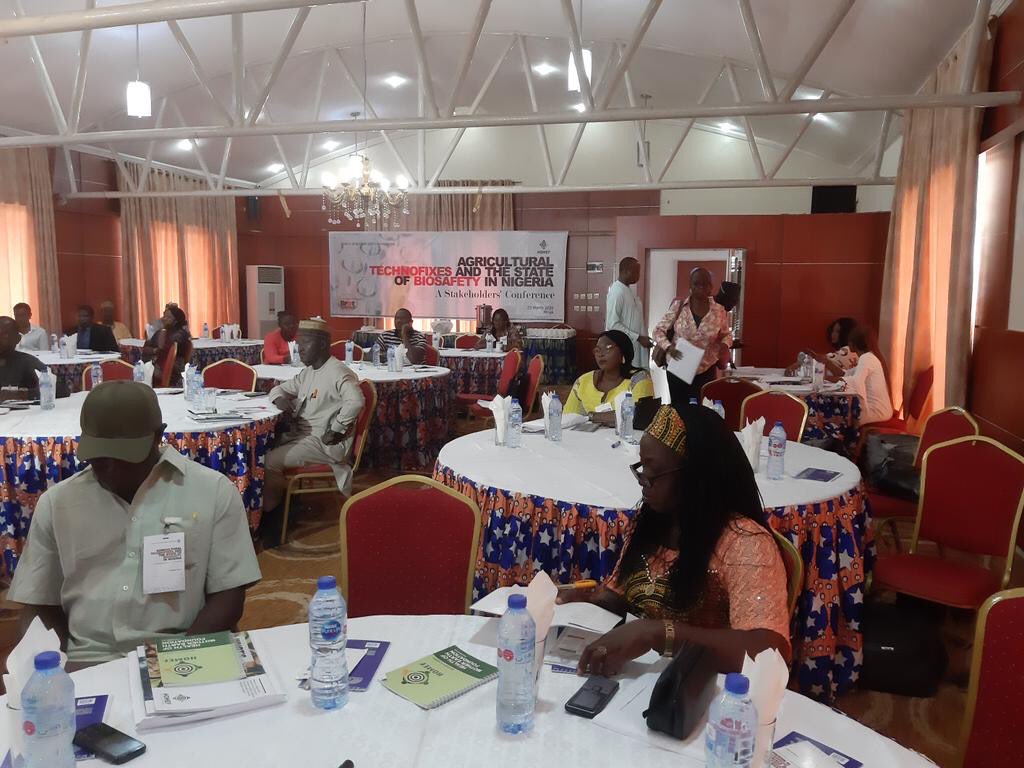 Technofixes and the State of Our Biosafety. A time like this demands and permits only sober consideration of where we are coming from, where we are and where we are heading to. The world is virtually shut down due to the ravages of a virus. This is no time for grandstanding or for anyone to claim that they have got anything under control. Interestingly, the virus is not a new organism. It has been around. It appears the consternation is over new variants that have emerged. If the virus has jumped to humans from bats, that would be a strong rebuke over the reckless ways that humans have degraded habitats of other organisms on the planet. If it has emerged from some biological weapons laboratory then it shows both the evil genius of humans and the strong warning that it is a short distance from rides on the back of a tiger and becoming dinner for the canine beast.
 The world is in the grip of a virus that could change many things. Coronavirus, that tiny, invisible organism, has reminded humans that there are things that are simply not under our control. The virus has attacked the rich and the poor, the powerful and the weak. It has largely taught us what equality could mean in an age when humility is not a common commodity. Now it has been formally declared a pandemic we must do our best to avoid any pandemonium even as towns and large swaths of nations have been locked down and large gatherings are avoided literally like there was a plague. At a time when it is normal for huge crowds besiege stadia to watch football matches, suddenly empty stadia are becoming the norm. Premier League matches are being postponed! Before Coronavirus it would have been crazy just to imagine that possibility. One can only wonder what this means for the economy of the world of soccer where players are happy to be traded like pawns on a board game.
 The world has been fatally seduced by petroleum. Multiple oil spills continue unabated in the oilfields of the Niger Delta. While the oil companies claim that they have bettered their sense of responsibility by detecting and remediating oil spill sites, these largely remain tales for the gullible. For communities whose soil, water and air have been assaulted for decades, hopes of having a safe environment, as suggested in the Objectives of State in Chapter 2 of Nigeria’s 1999 Constitution, or as clearly stipulated in Article 24 of the African Charter for People and Human rights, remain but pipedreams.
 Let’s look at activism, academia and politics. A conference on the intersection of academics and activism was recently held as part of events marking 40 years of the

 Will Ogoni be Cleaned? Recent news making the rounds is that the Nigerian National Petroleum Corporation (NNPC) and their oil company partners, Shell Petroleum Development Company (SPDC), Total Exploration and Production of Nigeria (TEPNG) and Nigerian Agip Oil Company (NAOC), have “disbursed” a total of $360 on the clean-up of the Ogoniland. This claim is
