Catholic Medical practitioners Caution on GMOs

This post is the EnviroNews report on the outcome of a recent scientific conference hosted by Catholic medical practitioners recently in Port Harcourt, Nigeria. You can also read the entire communique here: 2017 ACMP Communique in PH 

We reproduce the EnviroNews report:

Catholic Medical Practitioners have called on the federal government to legislate, regulate and monitor the introduction of genetically modified organisms (GMOs) in Nigeria.

While demanding that attention be payed to the labelling of GMO products, they demanded adequate funding for research and development by the GMO regulatory agencies for the nation to derive benefits from the technology.

“But more importantly, to protect our people and environment from the many possible dangers thereto: decreasing food productivity, food gene extermination, corruption of soil ecology, food insecurity and biological imperialism as well as various health hazards on human beings, the environment, animals and plants,” declared the Association of Catholic Medical Practitioners of Nigeria (ACMPN) in a communique released at the close of its 12th scientific conference and annual general meeting that had “Genetically-Modified Organisms: How Harmful, Harmless or Beneficial?” as the theme.

The event held from Thursday, July 6 to Saturday, July 8, 2017 in Port Harcourt, Rivers State.

The conference called on the government to re-commit to working for all Nigerians, truly developing a national consciousness on shared values.

They also want the government to lead Nigerians to possess, take ownership and protect the nation morally, socially, politically, and economically in a truly independent and progressive manner.

“The protection of lives of everyone, including the unborn Nigerians is a sacred duty for all, especially those in authority,” the medical practitioners noted, calling on the authorities to adequately train the personnel, equip and fund the national agencies mandated to protect the health and lives of citizens, the environment and natural resources.

“In this way, these agencies will not become mere facilitators and local proxy organisations for global businesses and so-called development partners whose underlying targets may be inimical to the strategic interests of Nigeria and her peoples.”

The conference further called on Catholic doctors to engage in health insurance and especially community-based health insurance to help citizens access health care, and for Nigeria to achieve universal health coverage to improve its current low indices.

It also called on all doctors of goodwill to adopt healthier, ethically and culturally adequate approaches in their maternal, child and family health care, rather than the values of the “culture of death”.

The ACMPN also re-committed itself to promote the sanctity of human life, marriage between a man and a woman, natural family planning and NaProTechnology in pursuit of family health and national development.

FishNet Dialogue At Okrika Waterfront

FishNet Conversations. True change can come from below. Change can begin from below. True change must come from below. Just as it is the root system that makes a tree stand, so it is with changes that must last. We have ignored the roots of our problems long enough and today we are dissecting those roots so that we can clearly see where the proverbial rain began to beat us.

Along the 853km coastline of Nigeria are men and women floating in turbulent tides, seeking to draw out the swirling foods that are in turn seeking their own food.  There are epic struggles on and in our waters: our fishing brothers, sisters, mothers and fathers struggle to catch the aquatic beings. The aquatic beings struggle not just to escape the nets and hooks, but also to catch a breath as they are suffocated by myriad pollutants and poisons. These realities extend along the coasts of our inland water bodies as well as the continental shorelines of Africa and around the world.

And, so, our stop today is for reflections on the health of our aquatic ecosystems and the challenge of offshore extractive activities and the economic situation of our peoples. Similar dialogues have commenced in South Africa where fisher folks are fighting for a right to fish on the piers of the Durban harbour without restrictions that blocks them away known fishing grounds. We have also had similar conversations at Kribi, Cameroun, where the entrance of the Chad-Cameroun pipeline has destroyed coral reefs and fisher folks have to go deeper into the seas in hope of having a meaningful catch.

As we gather today on this challenged Water Front in Port Harcourt, our FishNet Dialogue will examine the past and the present and draw up a picture of our preferred future. We are looking back at what the fishing situation was in the Niger Delta before the extraction of petroleum resources despoiled the marine environment. We are reflecting on what species were available and what ecological norms our ancestors applied to ensure a steady supply of nutritious foods and how they built the local economies. We are looking at what has happened since our territories became an industrial waste dump, where mangroves have been destroyed by many factors and where fishing grounds have been largely curtailed by military shields ringing oil and gas facilities. We will touch on the rising sea levels, eroding coastlines and the salinization of our fresh water systems. Importantly, we are reflecting on who are the culprits and what must be done and how.

Our hope is that, as we sit in this and other FishNet Dialogues, we will extend hands to other fishing communities along the entire coast of Africa (and beyond), share our stories and underscore the facts of our common humanity, our right to food and our right to live in dignity. We look forward to the day when it will dawn on all that fish is more valuable than oil. We are looking forward to the day when our voices will echo Fish Not Oil on our simmering tides. We are looking forward to the day when change will truly come from below and climate action will finally have as a pivotal hook the reality that offshore fossil fuels must be left untapped and unburned.

Fisheries contribute substantially to local economies and are a vital source of protein for most of our peoples. It is estimated that fisheries contribute up to N126 billion to Nigeria’s economy annually. Sadly, only about 30 percent of our fish needs are produced locally – and these come from artisanal, aquaculture and industrial fisheries. In the Niger Delta, it is a worrisome truth that many fisher folks have become fetchers of wood as the creeks and rivers have been so polluted that fishing has become largely unproductive. Fishing communities have been forced to depend on imported fish by pollution and by reckless and illegal harvesting of fish by foreign trawlers along our continental shelf. Starkly, some analyst believe that the Nigeria is the highest importer of fish in Africa.

It is time to challenge our policy makers to interrogate the essence of development and determine what truly makes economic sense. The offshore extractive sector employs a handful of citizens, but throws millions out of work due to the taking over of fishing grounds and the pollution of the creeks, rivers and seas. Although GDP measures do not put food on dining table or is not an index of well-being, for a notion of the economic implication, we consider the case of Ghana. As at 2011, the fishery industry accounted for nearly 5 percent of Ghana’s GDP and jobs in the offshore oil industry for Ghanaians were estimated to be around 400 with an expectation that this may double by 2020. Meanwhile, fishing directly or indirectly supported up to 10 percent of the country’s population. Think about that.

We must consider the grave impacts on the global climate by the world’s continued dependence on fossil fuels – an addiction that permits extreme extraction and the poking around for deposits in the deep sea. We question the economic sense of investing huge sums of money to set up drilling platforms and Floating Production Storage and Offloading (FPSO) stations in stormy, dangerous waters.

Offshore oil production involves environmental risks, the most notable one being oil spills from oil tankers or pipelines, and from leaks and accidents including facilities failure on the platform.  The materials used in the process of drilling are also a source for worry. We cite the example of drilling muds used for the lubrication and cooling of the drill bits and pipes. The drilling muds release toxic chemicals that affect marine life. One drilling platform can drill several wells and discharge more than 90,000 metric tons of drilling fluids and metal cuttings into the ocean.

We also have to consider produced water, a fluid brought up with oil and gas and making up about 20 percent of the waste associated with offshore drilling. At exploratory stages, seismic activities send a strong shock waves across the seabed that can decrease fish catch, damage the hearing capacity of various marine species and lead to marine mammal stranding. Many dead whales washed onshore in Ghana at the time seismic and oil drilling activities peaked in that country’s offshore. We also had similar experiences during offshore accidents, such as the Chevron rig explosion off the coast of Bayelsa State in January 2012.

Offshore oil rigs also attract seabirds at night due to their lighting and flaring and because fish aggregate near them. The attraction of fish to the rigs deprive fisher folks of access due to the naval cordon around the facilities. The process of flaring involves the burning off of fossil fuels which produces black carbon (a current menace around Port Harcourt) and constitute a source of greenhouse gases that compound the global warming crisis.

Fishery on the other hand has little or no negative externality on the people or environment. It is a source of food and food security as well. It is a source of job creation. And it does not harm the climate. Offshore extraction and its externalities point towards negative indicators and are prime sources of conflicts between nations. Our FishNet Dialogues aim to build local economies, fight global warming at the base and build a movement from below to ensure a liveable planet, support local economies and build peace.

Let the dialogue continue.

—————————–

Welcome words by Nnimmo Bassey, Director Health of Mother Earth Foundation, at the FishNet Dialogue held at Port Harcourt on 7 July 2017


A Hard Superhighway to Travel

Superhighway Map
Map of highway in EIA vision 4. Road to be realigned to avoid key forests

A Hard Superhighway to Travel. The Superhighway project has been controversial from the day it was first announced publicly for many reasons. First, it was routed without regard to the negative impacts it would have on the Cross River National Park (CRNP) and a number of community forests in its path. The path chosen initially for the 260 kilometres Superhighway was carved out in a manner reminiscent of how Africa was partitioned at the Berlin Conference of 1884 – probably over tea and coffee, or as men hunted for game, and for territories. The path showed a disregard for the unique biodiversity of the region and was equally mindless of the climate impact that would ensue from the massive deforestation that the project was bound to cause. There was also no clarity about how the CRSG would ensure that this is not a white elephant project that would only promote the harvesting of timber from the forest and leave a scarred environment and impoverished communities in its wake.

The 23 conditions attached to the approval of the Superhighway project underscore the fact that development must be relevant to its context and must be in the interest of the people and the environment.

The superhighway as initially proposed met stiff resistance because it appeared to have been poorly thought out and directly threatened over 180 communities, water sources, endemic plant and animal species and lacked clarity about what goods would be conveyed from the proposed “deep” sea port at Esighi to Katsina Ala. It also refused to acknowledge that there is an existing highway that is crying out for refurbishing and would very much serve the purpose of linking the end points of the proposed superhighway. What is the allure for this project? Could it be the label “super” attached to it or are there yet to be revealed intentions?

Four Environmental Impact Assessment (EIA) submissions down the line, it is now hoped that all stakeholders have learned valuable lessons in project inception and implementation. It should indeed be a sobering and humbling moment with nothing to celebrate for the proponents of the highway that has foisted unnecessary controversy over the supply of a rather basic infrastructure. The 260 km Superhighway has now elongated to 275.344 Km due to the need to avoid the Cross River National Park as well as community forests including the one at Ekuri.

One of the most vexatious impacts of the proposed highway at a point was the revocation of ownership of lands stretching a whopping 10 km on either side of the highway. 10 km on either side of the proposed highway! This was an extremely and ridiculously colonial idea treating the territory literally as a no man’s land. This idea was thrown in the trash bin by the CRSG after receiving much condemnation locally and internationally. We are pleased to see that the Federal Ministry of Environment is insisting that the CRSG should gazette the nullification of that revocation and restrict itself to 70m only as the permissible right of way. This will protect the communities that faced imminent displacement by that attempt at incredible and obnoxious land grab. We also note that one of the conditions is that those that have suffered harm from the project should be compensated. That is the way it should be. The task now is for all stakeholders to monitor and ensure that there is strict compliance with this condition.

The 23 conditions that the Federal Ministry of Environment requires CRSG to fulfil before they would receive the certificate of approval of the EIA necessitates careful study by all stakeholders. It should be carefully and critically examined by communities through which the highway would pass. They also provide civil society and other stakeholders with a template for the detailed monitoring of the overall highway project. Having a conditional EIA approval should be a call on the CRSG to return to the drawing board and get herself ready for the Herculean task of delivering a 275.344km highway that could have been avoided if only she had considered fixing the existing dilapidated Calabar Ogoja highway.

The insistence of the Federal Ministry of Environment that the right thing must be done will eventually help the CRSG to deliver a project that is sensitive to the needs of the people, is not too disruptive of the ecosystems and that will eventually do more good than harm. That is the whole essence of the EIA process. The process has never been political and the resistance by the communities and civil society has been strictly in line with the law.

The conditions require that the Cross River National Park must not be violated by the highway. It also requires that the highway must not tamper with the Ekuri Forest and others. It requires that those whose properties have been tampered with or may be destroyed by the project must be compensated. The gazetting of the cancellation of the revocation order on the 10km stretch on either side of the highway before the project proceeds will ensure that no one’s land is grabbed by stealth. The condition states that the CRSG must “gazette the reversal of revocation order on the acquisition of 10km on either side to the 70km span of the road corridor as well as the gazetting of the boundary of Cross River National Park within two weeks (2) of receipt of this letter.”

Superhighway Lessons

The conditional EIA approval is a win for everyone – the Federal and State governments as well as the forest communities and the planet as a whole. With the new routing of the Superhighway, there will be less deforestation and thus lessened climate impacts.

The lesson of the conditional approval of the EIA for the superhighway is that it took four attempts at EIA submission before the proponents of this project could come up with something close to passable. Stakeholders note that the CRSG took many decisions without adequate consultations with communities and other stakeholders. Communities were treated with disdain by aristocratic public officers who preferred monologues to dialogues. At a recent Community Dialogue at Akpabuyo, the community people all said they just woke up one day to see bulldozers destroying their crops, land and properties. In other words, they were not consulted. And they were not compensated. One of the conditions given before the EIA would be fully approved is that this anomaly must be corrected. This is a stiff rebuke for a behaviour that should be avoided in future.

We are also pleased to note that CRSG is to ensure that the updated maps in the new EIA must show that the “re-routed road corridor takes cognizance of the boundary of Cross River National Park and Ekuri Community Forest as well as conform to international best practices on setbacks for highways in critical ecosystems such as the proposed corridor.”

The conditional approval is also a stern rebuke for EIA consultants who believe that the exercise is perfunctory and that they can produce a cut-and-paste document with scant relevance to specific project locations. The entire process speaks volumes about the professionalism and quality of service being provided by officers who are saddled with the duties of watching out for the public good. This is where a huge gulf appears between those at the Federal Ministry of Environment and those at the ministry in the Cross River State. The superhighway saga provides a good opportunity for honing of needed skills, engagement with communities and other stakeholders and rebuilding the Cross River brand as a State that benefits from and is deeply appreciative of her cultural and ecological heritage, and acknowledges the intrinsic value of Nature and her gifts. It must also be kept in mind that projects of the size of the proposed highway have present and intergenerational implications. Even if we assume that we don’t owe ourselves an obligation to do the right thing, we cannot avoid a debt that we owe the future.


Food Security in the Niger Delta

Food Security in the Niger Delta can best be examined using the classic rule of thumb of the right to food and the right to be free from hunger. This basically requires that we approach the subject from the premise that we must own our food narrative. We shouldn’t be adjudged malnourished or hungry simply because we do not eat certain prescribed foods, in what manner and in what quantities. This necessitates that we consider the crucial need to approach food security in the context of food sovereignty.

The implication is that we have to focus on food that is produced by the people and that are culturally appropriate. This is vital, because food availability does not necessarily address the issue of food security if the people end up eating junk or are force-fed on foods they don’t really want. In the Niger Delta, as in the overall national situation, while we have spots where few citizens battle with mountains of food, the majority are drowning in the ocean of hunger.

Hunger arises due to a complex of socio-political realities.

Food is a human right. Food security is hinges on agriculture, property rights and environmental management. The deep link to agriculture is inescapable as the majority of our people are engaged in the production of food in one form or the other. And the story of the despoiled Niger Delta environment is well told.

In 1996, SERAC filed a case against the Federal Government of Nigeria at the African Commission Human and Peoples’ Rights denouncing “the widespread contamination of soil, water and air; the destruction of homes; the burning of crops and killing of farm animals; and the climate of terror the Ogoni communities had been suffering of, in violation of their rights to health, a healthy environment, housing and food. In terms of the African Charter, these allegations included violations of Articles 2 (non-discriminatory enjoyment of rights), 4 (right to life), 14 (right to property), 16 (right to health), 18 (family rights), 21 (right of peoples to freely dispose of their wealth and natural resources) and 24 (right of peoples to a satisfactory environment)”

When the Commission reached a decision in 2011, the FG was found culpable violating the people’s right to food. Thus, when we consider the food security in the Niger Delta we must keep in mind that there is a continued failure of the governments to uphold the right of the people to safe and satisfactory food and by extension, all the other rights.

Absence of food is a major threat to human security.

Food is available when food producers are able to invest their time, energy, resources and skills in the farming, herding or fishing and attain good harvests for subsistence or for commercial purposes. Food is accessible when it can be found within reach of the hungry, and critically so when they have the purchasing power to acquire it. Food availability is also anchored on the appropriateness of the items within the cultural context.

Moi moi
Moi moi wrapped in leaves, not plastics!


Production and consumption of food depend not just on current realities, but on the collective and cultural memories of the people. These include how seeds are acquired and from whom, as well as how they are sown and by whom. Are the seeds purchased or do farmers get them from what they had saved? Is planting solely individual effort or does it include the cooperation of neighbours and other communal configurations?

For farmers to supply food in quantities that cover their needs and leave surpluses for the market, they have to sow sufficient seeds of good quality and on good quality soil. The impoverishment of farmers could lead to reduction in the scope of their productive ability – including farm size, quality and quantity of seeds as well as their capacity to work.

Soil and Seeds

When soils are of poor quality, the best efforts of the farmers would be largely futile and unproductive. When the soils are bad, the harvests would be bad and seeds saved to be planted would be of poor quality and are bound to yield poorer harvests. In situations of this nature, farmers engaged in farming as a routine, on automaton, expecting little and getting nothing. With the depth of pollution in the Niger Delta, farming is often mere tradition.

Over the years, local food varieties have been lost or abandoned. Massive deforestation due to logging, land use conversion, infrastructure development and industrial activities threaten vital food sources.

What Changed?

Oil exploration and extraction have brought about major changes in food production and access in the Niger Delta. The impacts come through the entire chain: from seismic activities of the exploration stage to the production, transportation and eventual usage stages. Seismic activities in the seas have direct impact on aquatic life forms and drilling wastes impact both land and water bodies. Dumping of hundreds barrels of produced water into the environment adds to the deadly pollution. Oil spills from equipment failure and from third party interferences add to the tragic situation. Gas flares diminish agricultural productivity and the use of the furnaces to process foods contaminate and poison the people.

Indiscriminate harvesting of fish by international fleets raise unique security issues and wreak havoc on fisheries, further impoverishing local fishers.

Canalizations for oil sector operations have also damaged fresh water systems by bringing in salt water from the sea. This has marked implications for fish and agricultural productivity. Coastal erosion is Eating up farmlands and infrastructure.

The overall situation is so bad that fishermen and women depend on imported fish for sustenance.

When Security Breeds Insecurity

Paradoxically, the presence of security forces in the Niger Delta to some extent promotes insecurity in the region. This happens in the sense that the citizens are insecure in the presence of these officials. Curtailment of certain undesirable activities may also become impossible if those charged with halting them do nothing or get compromised in the process. Collective shaming and punishment as evidenced in the many checkpoints in the creeks and have been seen in the cases of Ogoni, Odi, Odioma, Gbaramatu and many others attest to this.

Military shields around oil and gas facilities reduce the fishing zones and keep fishers away from customary or known fishing zones. Fisher folks now have to go to international waters, at great cost and risks, if they hope to make any reasonable catch.

Dumping of industrial waste at sea further hampers the productivity of the efforts of the fishers. This has raised concerns for fisher folks in the Niger Delta and in nations with offshore extractive activities.

Biodiversity

The must assured way of ensuring food security in Niger Delta is the protection/management of the environment and the enhancement of her agricultural biodiversity. Agro-biodiversity is the one of the basic productive assets of family farmers. This will require a halt of the pollutions, including gas flaring going on in the Niger Delta. On a national scale, it would necessitate the repeal of the National Biosafety Management Act 2015 and the enacting of a National Biodiversity Management Act that would not only protect and ensure the preservation of our agricultural biodiversity but would help kick start a bio-economy based on nature’s gifts to the nation.

Working the Future

1. Clean up the Niger Delta, restore the environment and compensate the people for loses suffered
2. Government to support farming and fishing communities structurally – including agricultural extension services, finance, creation of fish markets, storage facilities and rural infrastructure
3. Research into and support biodiversity conservation and promote the building of an economy that is based on local knowledge as well as on the principles of Re-Source Democracy
4. Establish a National Biodiversity Management Agency – and cover Biosafety matters within this agency
5. Demilitarize the Niger Delta and encourage community policing instead.


Speaking points by Nnimmo Bassey, Director, HOMEF
at the Roundtable on Food Security in the Niger Delta, 29 July 2017 at Yar’Adua Centre, Abuja


Yaoundé by bus

LushYaoundé by bus. The station of Touristique Express SA at Douala is a well organised affair. When I arrived there at 7:45am that morning I found that the staff were at their duty posts and, were, well, very dutiful. My sights were on Yaoundé and the trip was set for 3.5-4 hours.

Bought the ticket. Checked in my bag. Passed the security screening. About to step on the bus, a demand for my international passport. For a moment, I wondered why she thought I wasn’t a Cameroonian. After all my village isn’t too far off Bakassi which Nigeria gifted Cameroon. Actually, I thought I looked more Cameroonian than the Cameroonians! Anyway. I present my national identity card. No way. Presented my driver’s license. No way. Rummaged through my bag and pulled out my passport. Okay. Happy now? No response.

I was dead worried I would be crammed up in the bus, but on getting on board I found the first-row seat empty and quite spacious. Plus, the bus had less than 50% occupancy. I wondered if a bus company in Nigeria would have left the station without waiting to fill up every empty seat.

8:00am prompt we inched out of the station. Their buses leave every hour so there was no fear of not getting one, if you weren’t time bound.

Announcements made in French and then in English. Key points for me were: that the toilet on the bus was strictly for urinary purposes. For any other need passengers were urged not to hesitate to contact the hostess. Fasten seat belts. All phones were to be set in vibration mode and conversations were to be in low tones. As this was announced someone at the rear of the bus was having a vibrant conversation on his phone. The bus would not stop for anyone to purchase anything on the way, we were warned. And there were pineapples, cocoyam, potatoes, black pears, mangoes at every village/town we passed. Some bush meat – dried and fresh ones too. Then I saw an animal of the cat family – perhaps an endangered species. And, later on, a guy hawking a live porcupine! 🤔🤔

The trip would take a whole of four hours. Seems we are heading for an adventure. 30 minutes into the trip tea and snacks were served. Yummy. 👅

40 minutes into the trip, the driver kept to a speed of between 60 and 80 km/hour mostly because of heavy trucks on the single lane road. Occasionally he shot up to 110km/hour – when he overtook the trucks. He kept going at a speed hovering around 100km/hour.  However, he overtook over solid lines (at curvy spots) at least 4 times during the trip. 😱😱

Lush vegetation most of the way. As expected.

Not too many potholes. In most places where there were potholes they were encircled with white paint and marked “ok.” Like saying: potholes are okay! 🚶

smashed

At about 25km to Yaoundé we suddenly came to a traffic hold up that literally stopped movements in both directions. At one spot for over 60 minutes. The hostess announced that there was an accident ahead. When we eventually moved, we saw that it was quite a gruesome accident involving a car and 2 trucks. Near Mbakomo.

A few moments later we are in the outskirts of Yaoundé. A journey of 4 hours was accomplished in 5. Instead of chaffing I used the time to complete my reading of The Book of Joy by Dalai Lama and Desmond Tutu with Douglas Abram. Then I used the remains of the time to edit HOMEF’s FishNet Dialogue guidebook. Redeeming the time!

Yaounde

Looking back as we pulled into the station at Yaoundé I could say that it was a comfortable trip. All five hours of it. 😇🙏


We are no GMO Guinea Pigs

We are not Guinea Pigs. Unjust, unsafe, unsustainable. These are the three key words that can be used to describe food systems based on genetic engineering and other chemical based agricultural systems that seek to pollute the environment and to overturn local knowledge, local food culture and local economies. Unjust because they are often introduced surreptitiously or illegally and without adequate information to the public. Unsafe because they are unnatural and because of the very process and nature of genetically engineered or modified organisms including by the inherent allergenicity of some of the organisms and the fact of some of them being basically insecticides. Unsustainable because they operate as monocultures and would eventually subvert African food systems, disrupt local economies, build dependency on agrotoxics and on monopolist seed companies.

The public needs to be repeatedly reminded that there is no evidence to assure the world of the safety of genetically modified organisms (GMOs). Products of modern agricultural genetic biotechnology are a real threat to our biodiversity, soils and ways of life. Pesticide crops do not only kill target pest but other beneficial organisms, including pollinators and those in human guts.

To gain a full understanding of the needless nature of GMOs, we must listen to our farmers, economists and scientists that are not tied to the apron strings of biotech corporations

We must never forget the fact that once GMOs are released into the environment they cannot be recalled and would persist, contaminate and literally poison our environment. There are proven agricultural systems that require government support through the provision of extension services, research, rural infrastructure and linkages of farms to markets. These are where our governments must step up to the plate. Literally.

We are talking about our right to know what is on our plates and our right to choose what we eat. It is worth saying again and again that what we eat must not eat us. We cannot allow forces that are against our best interests to drive our agricultural narrative and suggest that nutrition can only be manufactured in modern biotechnology laboratories. We must uncover every surreptitious effort to contaminate our agricultural and food systems. It is time to monitor our imports including those that come as food aid.

It is time to march against poison! Yesterday the world paused to think about our global environment. The theme for the day was Connecting People to Nature. The world resolved to Stand with Nature. GMOs do exactly the opposite – they don’t only disconnect us from Nature, the fight against Nature.

GMOs have been spectacular failures in Africa. GMO cotton failed with small scale farmers in South Africa’s Makhathini Flats. The crop recently failed and was banned in Burkina Faso. Investment on GMO cotton experimentations in Ghana have just entered the pause mode with the purveyor of the failed technology, Monsanto, withdrawing financial support.

It is incomprehensible that the Nigerian Biosafety Management Agency (NBMA) would permit the commercial placement in the Nigerian environment of a crop that has failed in a resounding manner just across our borders. This is the time for Nigeria to retreat from the GMO path before more damage is done. Populist propaganda for the technology will never eliminate the fact that GMOs are marketing tools designed to secure profits for corporate entities and to secure political control for neo-colonial and imperial forces. GMOs are the current epitomes of colonialism via the gastronomic route. They are being pushed by external political and commercial interests into Africa and the Nigerian government and her agencies should not play the willing tool to be used as the window through which Africa would once more become enslaved by forces ranged against her interests. This must be stated very loudly because the public has a right to know. If the current government inherited a dangerous programme from the previous government it should be bold enough to distance itself from it. Environmental corruption is infinitely more deadly than monetary thievery. The fight against corruption must include against the corruption of our food systems, socio-cultural and ethical codes.

We reiterate that we have a right to know that GMOs are against our interests, including in the health, economic, social and cultural spheres. We have a right to know that the threats that GMOs pose to us are real, present and dangerously intergenerational. We have a duty to state categorically that there are tested and successful and viable farming practices that are safe and should be promoted. That route is provided by agroecology, a system that is independent of controlling political, agrochemical and seeds corporations.

We have a duty to insist that the weak biosafety laws being pushed across Africa, and in contradiction to existing African Model Law on Biosafety, are not in our best interest. They are laws set up to permit atrocious assault on our health, agricultural and food systems. The NBMA Act 2015 is a prime example of a law begging to the drastically revised or repealed outright. The law is replete with provisions that block public information, promote conflict of interests promotes vested interests and restricts avenues for adequate punishment for harm caused.

To gain a full understanding of the needless nature of GMOs, we must listen to our farmers, economists and scientists that are not tied to the apron strings of biotech corporations. This understanding should place a responsibility on all of us to demand food safety and reject attempts to force our peoples to become guinea pigs in needless and dangerous experimentations.

——-

Welcome words by Nnimmo Bassey, Director, Health of Mother Earth Foundation (HOMEF) at the Stakeholders Workshop on GMOs held at Apo Apartments, Abuja on 06 June 2017


Forests: Connecting People to Nature

FOREST TOWN HALL RESOLUTIONS: What Nature has connected, let no person or government put asunder

Health of Mother Earth Foundation held a Forest Town Hall Meeting on Monday – June 5, 2017 in commemoration of World Environment Day, at Apo Apartments in Abuja. The meeting was attended by 150 people including representatives from forest communities, CSOs, government and the media. At the meeting, it was resolved that we will continue to demand for justice for our environment and communities. The following are the outcomes:

  1. Clarification of the Funding Source of Ekuri Community Forest

The following questions needs to be answered clearly and transparently: where are the funds for the Ekuri Superhighway coming from, what are the conditions attached to the funds and what are the implications for the economic autonomy of the community and state?

  1. Community Sensitization, Mobilization and Empowerment

Any successful community effort will require proper sensitization, mobilization and empowerment. The entry protocol will include identification of the power structures in the community, individually sensitize the opinion leaders, organize collective community dialogues and connect the community with resources to exercise their human rights provided according to the law. This will enable the community negotiate appropriate compensations, where necessary.

  1. Land Belongs to the People

A key bone of contention in environmental issues comes about from the lack of clarity (or wrong awareness) of the ownership of land. It was brought to light that land belongs to the people, according to combined interpretation of the Land Use Act as well as the Constitution of Nigeria. The government is a ‘keeper’ of the land and cannot carry out activities that will infringe on the rights of the people, without their consent.

  1. Regard for the Forest

The forest is more than a collection of trees. The town hall meeting resolved to demand a holistic regard for the forest and the intricate values it provides ecologically, socio-culturally, and economically. A plantation of trees cannot be used to replace a forest and the dependent communities that have existed for hundred of generations.

  1. The Super Highway is Unlawful and Unwanted

The community representative expressed severally that while they are in need of good roads to serve their needs, they require a repair / upgrade of the currently existing road which was abandoned by the previous government, instead of an unjustifiable ‘Super Highway.’

  1. Sustained peaceful protests and campaigns

HOMEF and all its partners belief solely in peaceful methods to creating  change, including the use of all forms of media. Sustained protest and campaigns will continue to create the pressure required for the government to pay attention to the needs, voices and rights of stakeholder communities.

  1. Community Organizing

When there is a desecration of the environment, several communities suffer the impact. It is imperative for communities to come together, work in solidarity and ensure that they combine efforts to get their voices heard.
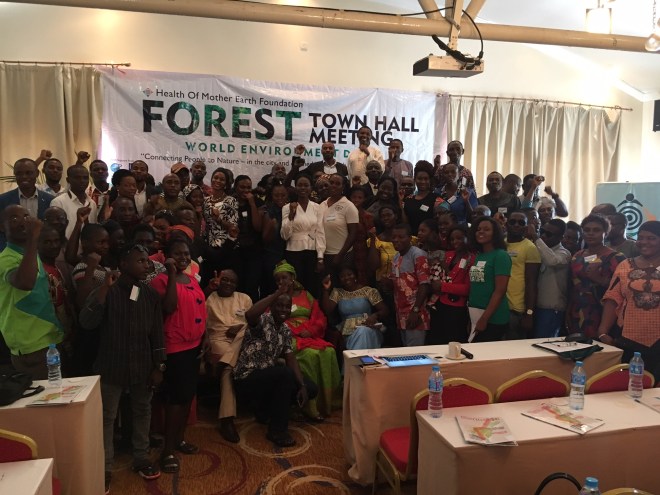
Group


Welcome words by Nnimmo Bassey at the Forest Town Hall:

What Nature Has Connected

The theme of this year’s World Environment Day, Connecting People to Nature, could not have been more apt, considering that humankind has lost the vital connections that make us conscious of our being a part of a community of beings on Earth.

Today we want to particularly look at the disruption of that connection by the politics of infrastructure that is sometimes pursued without recourse to national or even natural laws. We see roads build without drainages and where they are constructed, they are invariably emptied into streams and rivers without any consideration of the wellbeing of the aquatic life in them and of the people that depend on the water downstream.

I once asked the manager of a phosphate factory dumping toxic effluent into the Atlantic Ocean at Kpeme, near Lome, why such a harmful practice was permitted. The answer was that “you cannot make an omelette without breaking the egg.” If you ask why international oil companies have been routinely flaring gas in the Niger Delta over the past fifty-nine years, they claim it became “industry practice” because there was no market for the product when oil extraction commenced. Can you seen how low we can sink?

One of the infrastructural projects that has astonished the world and stunned local communities is the 260 km Superhighway proposed by the Cross River State Government (CRSG) to originate from a “deep sea” port at Esighi in Cross River State and rip through the National Park and community forests to terminate at Katsina Ala in Benue State.  This Town Hall meeting will examine what has been lost due to the commencement of the execution of the project without adequate public consultations, before an approved Environment Impact Assessment (EIA) and presumably before any detailed site-specific designs had been made. We will also examine what has been saved by the self-reversal of the order by which the CRSG had grabbed an amazing 10km span of land on either side of the proposed highway. That land uptake would have meant the displacement of several communities, conversion of pristine forests, decimation of wildlife and possibly the extinction of some species.

The idea of shaving pristine and protected forests for the installation of a highway of any form indicates a clear disconnection between people and Nature. The farcical community consultations so far carried out underscores the disconnection between the wielders of power and the citizens. The struggle waged by the communities to ensure that they are duly consulted and that their free prior informed consent is obtained before any project execution is an indication that a people connected to Nature would not readily allow any force to disconnect them from Nature on which they depend for livelihoods. This Town Hall will also seek to assure our threatened communities that we are united in the efforts to ensure that they are allowed to live in dignity, enhance their systems of knowledge and that the best interest of all beings is respected.

“We were not consulted before the superhighway was routed through our communities. We just saw bulldozers mowing down our trees, crops and properties. We insist that we must be consulted and that our consent must be obtained and due compensations paid for what has been destroyed and before any further work here. Our livelihoods depend on our environment. We cannot be treated like slaves in our own land.”

The forest dependent communities of Cross River State have shown exemplary commitment to protecting and managing their community forests. In attestation of their excellent performance, the Ekuri people were conferred with the Equator Prize by the United Nations Development Programme in 2004. Forests provide a variety of services to humans and other beings. Forests help to cool the Earth, protect our rivers, maintain soil quality, house wildlife. They provide food and medicine for humans and are home to pollinators. While the communities deserve to have good access roads, building any superhighway through the well managed forests would spell disaster of global implications.

Regrettably, Nature has become to many of us “a thing” that is to be appropriated, transformed and traded. We have gone so far from Nature that one sounds ridiculous to insist that we do not need to attach monetary values to Nature before we can protect her. This is the logic that undergirds the concept of Green Economy and promotes market environmentalism. We have forgotten the intrinsic values of the gifts of Nature and of Nature herself. We believe that all is not lost. We can wake up from the present nightmare and dream of better ways of living, of connecting with Mother Earth.

Today, we have deliberated chosen to mark the World Environment Day by having a Forest Town Hall Meeting. We note that parts of our nation are not being denuded by processes of desertification and the forest regions are rapidly becoming Sahellian.  The transformation cannot be blamed on climate change alone, although it does play a part in the area of desertification. Our disconnection from Nature has permitted us to clear our forests, destroy complex ecosystems, food systems and our social heritage without any reflections on the consequences of our actions. The loss of our forest ecosystems translates to the loss of culture, of ways of life, of possibly irredeemable destruction of species. These loses translate to direct deprivation of livelihoods and the exacerbation of poverty in our forest dependent communities.

We are pleased that the Federal Ministry of Environment has stood ready to review Environment Impact Assessment documents presented by the CRSG and that a nod would only be given when it is clear that all requirements of the law are met, including full consultation of the communities that would be impacted by the proposed project. We look forward to hearing thoughts and experiences from development and environmental experts as well as from representatives of communities threatened by the proposed that project.

I and my colleagues took part in an ecological community dialogue in Akpabuyo, one of the already impacted communities, last week. The lament of the people that still rings in my ear is this: “We were not consulted before the superhighway was routed through our communities. We just saw bulldozers mowing down our trees, crops and properties. We insist that we must be consulted and that our consent must be obtained and due compensations paid for what has been destroyed and before any further work here. Our livelihoods depend on our environment. We cannot be treated like slaves in our own land.”

What was implied is that we must not be disconnected from our land, from Mother Earth. In other words, what Nature has connected, let no person or government put asunder.


Unpacking Re-Source Democracy


Interrogating Re-Source Democracy. Progress has been measured by how much humans are able to transform Nature and increasingly this has been seen to be directly related to how exploitative of Nature and how polluting a nation or corporate entity can be. Clearly, the environmental crises confronting the world is inseparable from the economic crisis.

The current system denies reality. That is why the president of arguably the most powerful nation on Earth can wake up and exit from a global effort to fight a common challenge: climate change. That is when power trumps good sense. This myopic power denies science and even defies reasonable self-interest.   Although the Paris Agreement is largely inadequate, the pulling away of the USA, the second largest greenhouse emitter, from the global climate space, as outrageous as it is, only confirms that power only respects primitive, even harmful, self-interest.

The quest for materials and their transformation over the years have led to slavery, colonialism, autocracy and diverse socio-cultural corruption and manipulations. It has led to forceful dispossession of persons, communities and nations of their heritage through wars and other violent confrontations. This exploitative pathway, in which we have chiselled and drilled into the belly of the Earth, polluted our rivers and atmosphere, mowed down mountains, chopped down forests and poisoned our food systems, has taken humans further away from Nature over time.

Humankind’s quest for the control of Nature has led to the waging of unwinnable wars over natural forces and manifestations. Rising consumption and wastages have led to massive extinction of species and severe environmental changes – some of which may well be irreversible. Progress is largely measured by uniformity of products that yield to mass production, transportation and consumption. We seem to have forgotten that Nature thrives in diversities. This psychological and physical drifting from Nature is proving unsustainable as planetary boundaries and limits are being reached and exceeded.

The current global economic crisis will not go away as long as the current basis of relations stay. A capitalist economic system respects neither nature nor environment or peoples. It is based intrinsically on exploitative, competitive and non-regenerative relationships and cannot be sustained in perpetuity. When you don’t regenerate, you are not restorative and your actions are firmly planted on the path of degeneration. Even the accumulation of wealth by the 1 percent has reached its peak and the only way forward has to be down.

The current system denies reality. That is why the president of arguably the most powerful nation on Earth can wake up and exit from a global effort to fight a common challenge: climate change. That is when power trumps good sense. This myopic power denies science and even defies reasonable self-interest.   Although the Paris Agreement is largely inadequate, the pulling away of the USA, the second largest greenhouse emitter, from the global climate space, as outrageous as it is, only confirms that power only respects primitive, even harmful, self-interest.

Sustainability is not just a measure of a thing being available or useable in perpetuity. It also connotes its staying recognisable in form and speaks of intergenerational justice and responsibilities.

Re-Source democracy calls for a re-turn to the source, a re-connection to Nature. It calls for a recovery of memory. It calls for a dream of our preferred future or even multiple futures. It calls for the recognition of the fact that humans are just one of the species on Planet Earth and that we are a part of a system whose survival depends on interrelationships and solidarity.

To ensure Re-Source democracy, we have to be immersed in the defence of life and staying in the battle line against inequality as well as political and social injustices. We have to build a future that promotes cooperative and collaborative behaviours. That is what creates shared abundance, the good life or eti uwem. Scarcity is promoted by competition and that breeds all sorts of social and environmental misbehaviours.

Nature is self-regenerating, but human and corporate activities have brought in disruptions of those circles and cycles of life. Examples include the utter degradation of our environment by oil spills, gas flares, toxic wastes, industrial effluents and the like. It includes the exploitation of re-sources without prior informed consent of citizens in the territories. We have to pause to ask what the Niger Delta will look like by the close of the century. What would be the situation of the far North if desertification is not checked? What would be the case of our territories if gully erosion and deforestation continue unabated?

Environmental degradation disrupts our linkages to Nature, shrivels our humanity and throws us into unhealthy rivalry and struggles for whatever goods remain. It alters our thought patterns and social relations. It makes the unacceptable appear attractive and even acceptable. How would anyone drink water that is visibly polluted or eat foods that are clearly known to be toxic? How would we accept these without major uprisings?

What would make Nigeria stay in the present unsuitable unitary national architecture fabricated by military adventurers to suit their command structure? How could we dream of building a democratic and federal nation on the basis of autocratic and dictatorial military scaffolds? More questions can be asked, but let us restrict ourselves to the way we have treated Nature’s gifts to our nation. The arrival of crude oil and petroleum resources literally poisoned and damaged our environment, economy, politics and socio-cultural relationships. Agriculture got ignored, manufacturing got side-lined and all eyes got riveted on US dollars flowing into the national pot. We became captives of voodoo economics. Do nothing, grab everything.

Re-Source Democracy requires that we train our eyes to see what Nature has presented to every community and to what extent the communities are involved in decisions that affect the exploitation, protection or use of the re-sources in their territories. It requires that no one gets killed or colonised simply because of such endowments. It requires that we question how what we have is utilised and on what basis. It is about our right to life, freedom from contamination and respect of the Rights of Mother Earth.

We have hopes that unpacking the concept of Re-Source Democracy will provide us with ideas on how to redirect the nation from divisive and exploitation pathways and provide the platforms for truly democratic relationships with each other and with Nature – one that is built on local knowledge and wisdom. It should help us cultivate mutual respects between the many groupings in our nation. It should above all help encourage us to handle the gifts of Nature with due deference.

The Faculty of Social Sciences, University of Uyo provides an excellent academic environment for the interrogation of this existential challenges. And we are happy that you have welcomed us to be part of this conversation and probably many others to follow.

—-

Remarks by Nnimmo Bassey, Director of Health of Mother Earth Foundation (HOMEF), at the Sustainability Academy on the theme Unpacking Re-Source Democracy held at Bath Ebong Hall, University of Uyo on 2nd June 2017


Resilience, Resistance

Building a Resilient and Ecologically Engaged Citizenry. Cross River State is generally seen as a green state, with some of the last tracts of pristine rain forests – some of which have been preserved through community forest management efforts. Some of us believe that what the State needs is an economy creatively built on her bio-economic endowment. Such an approach would release the creative potentials of the citizens in an inclusive manner with inbuilt resilience. The rich soils and biodiversity of the State have however become a compelling pull for plantation or monoculture developers. Their incursions have put pressure on the local communities, especially the forest dependent ones. The incursions also have grave implications for national and global efforts to tackle global warming.

The suggestion that plantations are forests has been rejected by our peoples who insist that forests are biodiversity hotspots and that there can be no mono-cultures without the destruction of biodiversity. Biodiversity erosion degrades the resilience of communities at many levels – ecological, spiritual, economic, social and cultural. Biodiversity destruction can come from many actions including land use changes arising from conversion of forests into plantations as well as from infrastructural projects.

The controversies surrounding the Superhighway project idea have been consistently on rather basic premises. While some ask to know what would be exported at the Sea Port where the highway is to begin, others ask to know if the imported goods would terminate at Katsina Ala or where else they would go and how. These questions skirt the issue of the prime reasons offered for the Superhighway project – the urgent need to open up the State to investors and for development. The clouds over the project have been sustained by the lack of adequate public consultations on the routing of the highway, its necessity, its finance and viability and the trade-offs with regard to the massive community displacements and biodiversity destruction that would accompany it. Non governmental organisations (NGOs) like GREENCODE and Peace Point Action (PPA) have proposed that a railway system would be more cost effective in conveying goods from the seaport to the hinterland, besides having less impact on the environment.

These concerns have led communities and other citizens to demand a transparent Environmental Impact Assessment (EIA) process. That process has been unexpectedly tortuous for the Cross River State government (CRSG) because consultants engaged to help prepare the documents could not know, as pointed out by Rainforest Resource and Development Centre (RRDC), that there are no Chinese alligators, blue monkeys or even dams that would be found on the proposed Superhighway route. The versions so far seen appear to be cut-and-paste documents with scant relevance to the localities to be traversed by the Superhighway.

The CRSG has struggled to listen to public complaints and has reversed itself on the astonishing move it had made to grab 10km on either side of the proposed superhighway in order to create what had been described as a “development corridor”. That land uptake would have grabbed 25 percent of the landmass of the state and displaced up to 180 communities in the process.  Secondly, the CRSG is said to have realigned the superhighway so that it doesn’t traverse forest reserves. The problem with this is that with the route still falls within the fringes of forest buffer zones, the threats of illegal logging and opportunistic poaching remain very high.

Unfortunately, the CRSG has not been able to build the confidence of the public on the gains that the changes could have brought. This situation arises from the fact that while renouncing its initial edict to grab 10km on either side of the Superhighway, as well as sending out signals that the routing has been reconsidered, there have been threats and ultimatums made to the effect that the CRSG would proceed with the project even if the requirements of the law are not met; that they would consider revoking the ownership of the Cross River National Park. Moreover, the new routing of the proposed realignment of the Superhighway is still a conjecture as the revised map is not in the public view. The only maps that are accessible are those produced by the Wildlife Conservation Society (WCS). This speaks volumes about the preparedness of the State for the prosecution of this project in a way that addresses the concerns of the people and the unassailable need to protect our ecological heritage.

Today we are gathered here in Akpabuyo for a diagnostic Community Dialogue on the state of the local environment. We will examine issues including threats to our biodiversity and livelihoods. We will also examine what steps can be taken to preserve and enhance local livelihoods especially under the canopy of our reconnecting with nature, discussing re-source democracy and examining how to promote positive changes in the communities while minimising those with negative impacts. The purpose of our engagement today is to facilitate a process of distilling existing knowledge and bringing out action points that would build an ecologically engaged, resilient and proactive citizenry.

Our series of dialogues cover many ecological zones and have been supported by hosting communities, SGP-GEF of the United Nations Development Programme, Rosa Luxemburg Stiftung and Grassroots International. We thank leaders of Akpabuyo Community for making our dialogue today possible. We are also grateful to all the civil society groups and the media that are with us on this ecological journey.

We are only as resilient as our environment is. Let the dialogue continue.


Welcome words by Nnimmo Bassey, Director of Health of Mother Earth Foundation (HOMEF), at the Community Diagnostic Dialogue on the theme Building Resilience for Resistance held at Akpabuyo, Cross River State on 30th May 2017

Women, Re-sources, Peace and Matters Arising


Nnimmo May 24Although women are rarely those that trigger wars and the arms race, they are often the victims and bear the brunt of the harms that occur during the conflicts. Each International Women’s Day for Peace and Disarmament gives us a unique moment to reflect not just on what women suffer from the needless primitive conflicts raging in the world today, but on what women contribute to peace building in our world.

Whether conflicts are of the low or high intensity type, people suffer. Women suffer multiple deprivations in conflict situations. They bear the scars of injuries from weapons of war and also of being taken as trophies of war by deviant arms bearing men.

It is a common saying that peace is not necessarily the absence of war. In other words, the fact that there is no war does not mean that there is peace. Can we say there is peace when women are deprived of their rights to own or inherit land and other properties in certain nations? Is there peace when the environment is polluted and livelihoods are destroyed without any sense of responsibility? What about when citizens have no say as to what extractive activities are conducted in their territory or communities? Is there peace simply because deprived citizens do not bear arms?

These are questions that a day like this provides space for us to reflect on.

It is a day for us to pay tribute to women who have made valiant efforts to halt the reign of terror in the world. It is also a day to remember the girls and women that have survived the worst that terror and security forces have thrown at them. On this score, we remember the Chibok girls – released and in captivity. We salute the courage of women who have unashamedly stood up against oppression by adopting the naked option. Here we call to mind that the Rumuekpe Women Prayer Warriors used this method in their protest to the Rivers State Governor’s office and to the Rivers State House of Assembly in November 2010 demanding for action to restore peace to their community.  Others have done the same in protests against the despoliation of their environment by international oil companies operating with recklessness that would not be condoned anywhere in the world. And we cannot forget the Abriba women who a few days ago adopted the naked option peaceful protest in the face of brutal naked power.

These are matters that a day like this provides space for us to think about.

Our women have been outstanding Amazons as they tackle very hostile environmental realities in the Niger Delta. Oil spills, toxic wastes, and gas flares pose unique challenges to the health of our environment and peoples. Climate change adds to the growing list of woes that our women must contend with. These range from the shrinkage of Lake Chad, loss of coastal lands to erosion and unpredictable weather conditions. The impact on food production weigh heavily on the shoulders of our women. And how about the phenomenal conflict between herdsmen and farmers that often manifest in the rape and killing of women?

These are happenings that a day like this provides space for us to chew upon.

Our women have literally built peace with bare knuckles, so to speak, while governments around the world invest on the machines of war – cutting down and shedding innocent blood in their quest for power and control. With climate denialists in high political offices, investment in warfare puts women at greater risks, reduces humankind’s resilience to global warming, makes nonsense of efforts to pursue the United Nations Sustainability Goals. With almost 2 trillion dollars wasted on warfare yearly, whole cities destroyed as though in video games, there is little or no money for climate mitigation and building of resilience.

These are issues that a day like this provides space for us to act on.

In a series of community dialogues and sustainability academies, HOMEF’s instigators will examine how the concept of Re-Source Democracy can be interrogated and implemented to ensure that the rights of Mother Earth are not trampled underfoot and that conflicts related to the use of the gifts of Nature are eliminated as we all reconnect to hers. As we salute our valiant women who have done much to build peace in our part of the world, I invite you to sit back and receive the words that will be coming from the indefatigable Ambassador Nkoyo Toyo and the high achiever, Mrs Joy Akate Lale. We will also today be honouring the excellent legacy of peace built by the Rumuekpe Women Prayer Warriors. We are thankful to the Vice Chancellor, Prof Ndowa Lale, and the entire management team of the University of Port Harcourt for providing an excellent space for learning and for the contestation of ideas. We are also honoured to have a great peace activist in our midst, Alyn Ware, winner of the Right Livelihood Award 2009, all the way from New Zealand.

The issue of Re-Source Democracy is worth a peep on a day like this.

Re-Source Democracy by HOMEF is available online at http://www.homef.org/sites/default/files/pubs/resource-democracy.pdf. Let us see an excerpt:

Re-source Democracy requires that we recognise the fact that we do not have to exploit a re-source simply because we have it. Some places must be off limits to extractive activities especially when such re-sources are found in fragile ecosystems or in locations of high cultural, religious or social significance. Lack of respect for certain ecosystems lead to the over-harvesting of re-sources and habitat loss. These in turn could lead to biodiversity erosion and species extinction. There are examples of nations that have decided against the exploitation of certain natural re-source in order to support the higher objectives of clean and safe environments ensure citizen’s wellbeing. Examples include El Salvador where mining has been proscribed and Costa Rica where crude oil is le in the soil.

The benefits of re-source democracy include elimination of conflicts, community involvement in re-source governance and protection based on knowledge and assurance of access. It ensures an integrated and sustainable use of natural re- sources in a manner that is fully in consonance with socio-cultural, religious and political dictates. Re-source democracy ensures that we all join together in acts of solidarity to defend the natural re-sources on which we inevitably depend for our survival. It does this by recognizing the rights of nature to replenish itself, maintain its vital cycles and do so without destructive interventions by humans.

Re-source democracy gives us rights and also responsibilities. It is an inescapable construct in an era where human greed massively damages ecosystems, depletes re-sources and threatens to exceed the carrying capacity of the earth.


Welcome words by Nnimmo Bassey at Sustainability Academy on Re-Source Democracy/Conflicts on the occasion of International Women’s Day for Peace and Disarmament co-hosted by the Centre for Conflict and Gender Studies, University of Port Harcourt and Health of Mother Earth Foundation (HOMEF) on 24 May 2017.